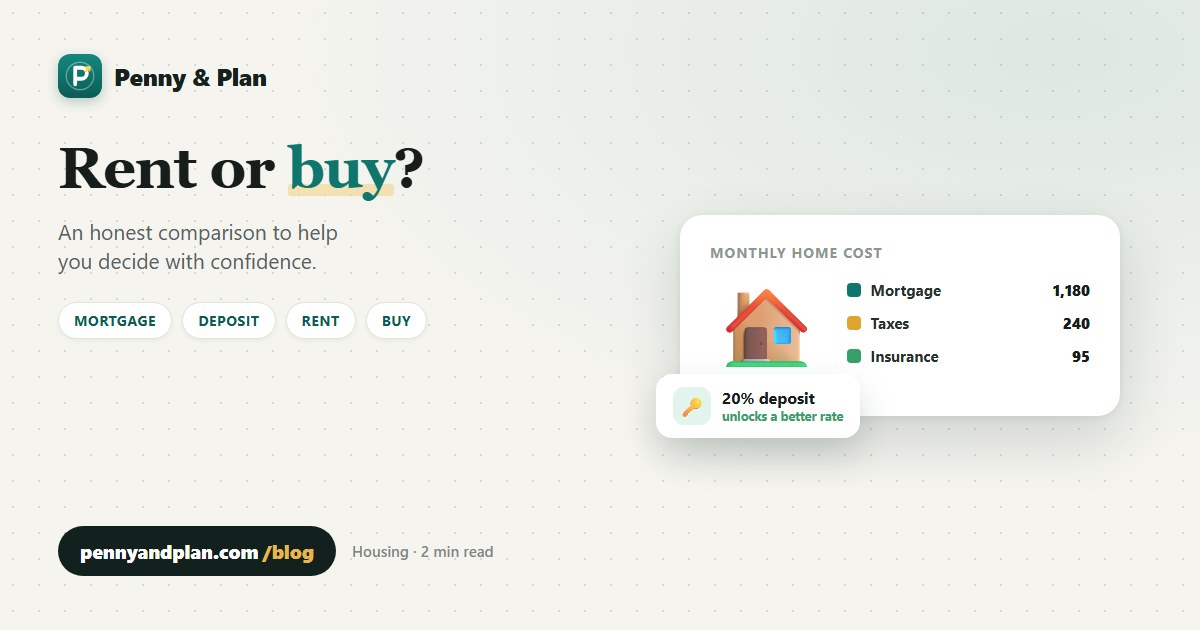
Renting vs Buying a Home: Which Is Better for You?
Renting versus buying is one of the biggest money decisions most people make, and it is often framed as obvious: buying good, renting bad. The reality is more balanced. Here is an honest comparison to help you decide.
The case for buying
- You build equity. Each mortgage payment chips away at what you owe, so over time you own more of a valuable asset.
- Stability. No landlord can ask you to leave, and your main housing cost can be more predictable.
- Freedom to change the home. You can renovate and decorate as you like.
- Potential appreciation. If property values rise over the long term, your asset grows in value.
The trade-offs: a large deposit tied up, plus ongoing costs many people forget, maintenance, repairs, insurance, taxes and mortgage interest, none of which build equity.
The case for renting
- Flexibility. You can move relatively easily for a job, a relationship or a change of scene.
- Lower upfront cost. A deposit for renting is far smaller than a deposit for buying.
- No maintenance bills. When the boiler breaks, it is usually the landlord's problem, not yours.
- No exposure to falling prices. If the market drops, it is not your loss.
The trade-off: you build no ownership, and your rent can rise over time.
The costs people forget
The honest comparison is not "rent versus mortgage payment." Both sides have money that never comes back:
| Renting costs that do not return | Buying costs that do not return |
|---|---|
| Rent | Mortgage interest |
| Property taxes | |
| Home insurance | |
| Maintenance and repairs | |
| Buying and selling fees |
When you include all the buyer costs that do not build equity, the gap between renting and buying is often smaller than it first appears, especially in the early years.
The question that usually decides it
More than anything, ask: how long do I plan to stay?
- A few years: renting often wins, because the big upfront costs of buying have little time to pay off.
- Many years: buying usually wins, because those upfront costs spread out and equity builds.
Then layer in your finances (do you have a deposit and stable income?) and local prices (in some areas buying is far cheaper than renting per month, in others the reverse).
The bottom line
Renting is not throwing money away, and buying is not automatically the smart move. Buying builds equity and stability but demands a big deposit and ongoing costs; renting offers flexibility and lower upfront cost but no ownership. Weigh how long you will stay, your finances and your local market. The right answer is the one that fits your life, not a blanket rule.
Frequently Asked Questions
Is it better to rent or buy a house?
It depends on how long you will stay, your finances and local prices. Buying tends to win the longer you stay because upfront costs are spread over more years and you build equity. Renting can be better if you value flexibility or plan to move within a few years.
Is renting really throwing money away?
Not entirely. Rent buys you flexibility, no maintenance costs and no exposure to falling house prices. Buyers also spend money that does not build equity, such as mortgage interest, taxes, insurance and repairs. Both options have costs that do not come back.
How long should I plan to stay before buying makes sense?
There is no fixed rule, but the large upfront costs of buying, such as the deposit and transaction fees, take time to earn back. The longer you stay, the more those costs are spread out, so buying usually makes more sense over a longer horizon.
Keep reading
 Subscriptions
How Much Does YouTube Premium Cost? Is It Worth It?
YouTube Premium prices went up in 2026. Here is what every plan costs, how the US, UK and Canada compare, and whether it is worth paying for each month.
Subscriptions
How Much Does YouTube Premium Cost? Is It Worth It?
YouTube Premium prices went up in 2026. Here is what every plan costs, how the US, UK and Canada compare, and whether it is worth paying for each month.
 Subscriptions
How to Cancel Audible and Keep Your Books
Cancelling Audible does not delete your audiobooks, but it does wipe your unused credits. Here is how to cancel properly and keep everything you paid for.
Subscriptions
How to Cancel Audible and Keep Your Books
Cancelling Audible does not delete your audiobooks, but it does wipe your unused credits. Here is how to cancel properly and keep everything you paid for.
 Subscriptions
How to Cancel Disney Plus (Any Device)
Cancelling Disney+ depends on who bills you. Here is exactly how to cancel on the website, iPhone, Android, Roku, Amazon and bundles, plus what happens next.
Subscriptions
How to Cancel Disney Plus (Any Device)
Cancelling Disney+ depends on who bills you. Here is exactly how to cancel on the website, iPhone, Android, Roku, Amazon and bundles, plus what happens next.