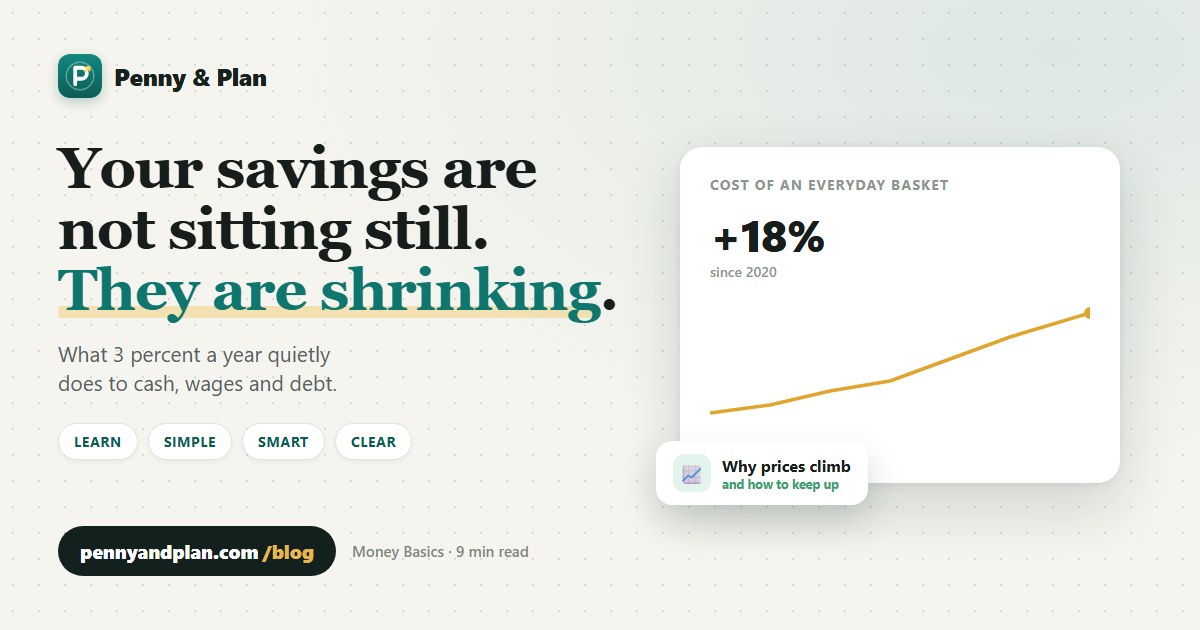
What Is Inflation and How Does It Affect Your Money?
Put 20,000 in a current account today, touch none of it, and come back in ten years. The balance will still read 20,000. But if prices rise at 3 percent a year over that decade, that pile buys roughly what 14,900 buys today. You did not spend a penny of it, and just over 5,000 of it is gone.
That is inflation. Not an abstract economic indicator, but a slow, silent transfer out of anything you hold in cash.
Inflation is a rate of change, not a price level
The word describes how fast prices are rising, expressed as a percentage over twelve months. Statisticians build a basket meant to represent what a typical household actually buys, price every item in it month after month, and track how much the total cost moves.
Three agencies do this work in the three countries covered here:
| Country | Index | Published by | Central bank target |
|---|---|---|---|
| United States | CPI-U, plus the PCE index the Fed watches most closely | Bureau of Labor Statistics | 2 percent over the longer run |
| United Kingdom | CPI, and CPIH which includes owner-occupier housing costs | Office for National Statistics | 2 percent |
| Canada | CPI, plus core measures that strip out volatile components | Statistics Canada | 2 percent, inside a 1 to 3 percent control range |
Two details are worth carrying with you. First, all three central banks target a small positive number rather than zero, so a gentle erosion of your cash is the intended state of the world, not an emergency. Second, the UK publishes CPIH alongside CPI specifically because housing costs for owner-occupiers are a large real expense that plain CPI leaves out. If you own your home in the UK, CPIH is usually the closer read on your actual experience.
The only number that matters for your money is the gap
Here is the shift that makes inflation useful rather than merely annoying. Stop looking at the inflation rate on its own, and stop looking at your interest rate on its own. Look at the distance between them.
That distance is your real return.
Say your savings account pays 4 percent and inflation is running at 3 percent. Your 20,000 becomes 20,800 after a year. But you needed 20,600 just to buy the same shopping as before. Your real gain is roughly 200, not 800. You earned about 1 percent, not 4.
Flip it. A savings account paying 1 percent while inflation runs at 3 percent is not a slow gain. It is a loss of about 2 percent a year, reliably, forever, no matter how green the number in the banking app looks.
This is why "I keep everything in savings because I do not want to lose money" is one of the more expensive sentences in personal finance. The account with a guaranteed positive number on the statement is guaranteeing you a negative real return whenever the gap goes the wrong way.
What 3 percent actually does over time
Small percentages are easy to dismiss because the annual damage looks trivial. It compounds like everything else.
Here is what 20,000 in cash is worth in today's buying power at different rates:
| Years | 2 percent inflation | 3 percent inflation | 5 percent inflation |
|---|---|---|---|
| 5 | 18,110 | 17,250 | 15,670 |
| 10 | 16,410 | 14,880 | 12,280 |
| 20 | 13,460 | 11,070 | 7,540 |
The quick mental shortcut is the rule of 72. Divide 72 by the inflation rate and you get roughly the number of years for prices to double. At 2 percent, prices double in about 36 years. At 3 percent, about 24 years. At 6 percent, about 12 years. That last one is why a couple of high-inflation years feel so much worse than the arithmetic suggests they should.
Where it lands, ranked from worst to best
Inflation does not hit everything you own equally. Sorting your finances by how exposed each piece is tells you where to actually spend your attention.
Cash sitting in a low-rate account. The most exposed thing you own, and usually the largest unexamined pile. Emergency funds have to live somewhere accessible, so accept the erosion on three to six months of expenses and stop worrying about it. What deserves scrutiny is the money beyond that sitting in the same place out of habit.
Fixed income that is not indexed. A pension or annuity paying a flat amount for life loses buying power every single year. Over a 25-year retirement at 3 percent inflation, a level payment ends up worth under half what it started at. Some payments are protected: state pensions in all three countries are uprated, and index-linked products exist for exactly this reason. Level private annuities and old defined-benefit slices often are not.
Your wages. A 3 percent raise in a 3 percent inflation year is not a raise. It is standing still with extra paperwork. This reframing is worth taking into any salary conversation, because "I would like to keep pace with prices, plus be paid for the extra scope I took on" is a stronger and more concrete ask than a round number pulled from the air.
Long-term fixed-rate debt. This one runs the other way, and it is the closest thing to a free lunch inflation offers. A fixed mortgage payment of 1,500 a month is still 1,500 a month in year ten, but after a decade of 3 percent inflation it costs you about 1,116 in today's money. Your income has drifted up with prices while the payment did not move. Note the two conditions: the rate has to be fixed, and the term has to be long. Variable-rate debt gives you none of this, because rates usually rise in response to inflation, and short-term expensive debt like a credit card balance gives you none of it either.
The tax trap most articles skip
This is where the three countries genuinely diverge, and where inflation quietly costs people money they never see leave.
If prices rise but tax thresholds do not, a pay rise that merely keeps pace with inflation can still push you into a higher band or reduce a benefit. Economists call it fiscal drag. You pay a larger share of your income in tax while being no better off in real terms.
United States. The IRS adjusts tax brackets, the standard deduction and many contribution limits for inflation annually, so the headline income tax system is broadly protected. Several important figures are not indexed, though, and those are the ones to watch. Social Security payments receive an annual cost-of-living adjustment based on a consumer price index measure.
United Kingdom. This is the sharpest case of the three, because thresholds are set by government policy rather than automatically indexed, and freezing them has been used as a deliberate revenue measure. When the Personal Allowance and the higher-rate threshold are held flat while wages rise, more of your income crosses into tax each year without any rate ever changing. The Personal Savings Allowance is a further squeeze, since interest that is purely compensating you for inflation is still taxable interest once you pass it.
Canada. The Canada Revenue Agency indexes federal tax brackets and many credit amounts to inflation each year, and Old Age Security payments are adjusted quarterly. Provincial systems differ, and not every province indexes on the same basis, so where you live changes the answer.
There is a second tax quirk worth naming across all three: tax is charged on nominal gains, not real ones. If an investment rises 3 percent in a 3 percent inflation year, you have gained nothing in buying power but you may still owe tax on the gain. That is one of the strongest arguments for filling tax-sheltered accounts first, whether that is an ISA, a TFSA, a 401(k), an RRSP or an IRA.
What actually helps, honestly ranked
There is no single hedge that works in every episode, and anyone selling one is selling something. What consistently helps is boring:
- Do not hold more cash than the job requires. Emergency fund yes, long-term savings pile no.
- Make the cash you do hold earn the going rate. The difference between a legacy account and a competitive one is often several percentage points, which is the entire inflation problem solved with one transfer.
- Own productive assets over long horizons. Companies raise their prices too, which is why broad equity exposure has historically kept ahead of inflation over decades, though not reliably over any given year or two.
- Consider explicitly index-linked products for money you cannot risk. The US offers I bonds through TreasuryDirect, whose rate has a component tied to CPI. The UK and Canada have had index-linked government issues, with availability to retail buyers varying over time.
- Fix your borrowing rate when you can, on long debt. Then let inflation work in your favour for once.
- Reprice your subscriptions and insurance annually. Providers apply inflation to your renewal automatically. Almost nobody applies the same discipline in the other direction.
Inflation and the wider economic cycle tend to arrive together, so it is worth reading this alongside how to prepare for a recession, since the two problems ask for partly overlapping and partly opposite responses.
One clarification that saves a lot of confusion
When a headline says inflation has fallen, prices have not fallen. Inflation dropping from 6 percent to 3 percent means prices are still climbing, just at half the previous pace. The level never came back down. This is disinflation, and it explains the gap between improving official statistics and the unchanged shock at the till.
Prices only genuinely fall when inflation goes negative, which is deflation, and it is rarer and generally worse for an economy than mild inflation. That is precisely why central banks aim for a small positive number instead of zero.
The bottom line
Inflation is the rate your money loses buying power, and at the 2 percent all three central banks target, it is a permanent background condition rather than an event. Judge everything by the gap between what you earn on your money and what prices are doing, not by either number alone. Keep only as much cash as the job needs and make that cash earn the going rate, own productive assets for anything with a long horizon, fix your long-term borrowing where you can, and check once a year whether your tax thresholds moved with prices or quietly stayed still.
Frequently Asked Questions
Is inflation always bad for your money?
Not for everything you own. Inflation is bad for cash, for fixed incomes that are not indexed, and for tax thresholds that are frozen. It is genuinely good for anyone holding long-term debt at a fixed interest rate, because the payment stays the same while wages and prices rise around it. Central banks in all three countries deliberately aim for a small positive rate rather than zero, because mild inflation gives them room to cut rates in a downturn and keeps households from postponing spending.
What is the difference between inflation and the cost of living?
Inflation is a rate of change measured across a national basket of goods and services. Your cost of living is what you personally spend. They can diverge sharply, because the official basket is an average across all households. If a large share of your budget goes on the categories rising fastest, such as rent, energy or food, your personal inflation rate will run above the headline figure even though the headline figure is correct.
Does falling inflation mean prices are coming down?
No, and this is the most common misunderstanding. Falling inflation, or disinflation, means prices are still rising but more slowly than before. Prices only actually fall when inflation goes below zero, which is called deflation and is rare. So a headline saying inflation has halved does not mean anything on your receipt got cheaper. It means it is getting more expensive at half the previous pace.
Sources
Primary sources used for this guide. Last checked August 25, 2026.
- Consumer Price Index for All Urban Consumers (CPI-U)Federal Reserve Bank of St. Louis (FRED)
- Why does the Federal Reserve aim for inflation of 2 percent over the longer run?US Federal Reserve
- Inflation and price indicesOffice for National Statistics
- Inflation and the 2% targetBank of England
- Consumer Price IndexStatistics Canada
- Monetary policyBank of Canada
Keep reading
 Money Basics
What Is Financial Independence and How to Reach It
Financial independence explained: the 25x rule, a savings-rate table, a worked example, and the US, UK and Canada rules that decide when you can spend it.
Money Basics
What Is Financial Independence and How to Reach It
Financial independence explained: the 25x rule, a savings-rate table, a worked example, and the US, UK and Canada rules that decide when you can spend it.
 Money Basics
Needs vs Wants: How to Tell the Difference
A three question test that sorts any purchase into needs or wants, a four tier ranking for tight months, and how the line shifts in the US, UK and Canada.
Money Basics
Needs vs Wants: How to Tell the Difference
A three question test that sorts any purchase into needs or wants, a four tier ranking for tight months, and how the line shifts in the US, UK and Canada.
 Money Basics
What Is a Recession and How to Prepare for One
How recessions are actually declared in the US, UK and Canada, why the call always arrives late, and the runway maths that decides how hard one hits you.
Money Basics
What Is a Recession and How to Prepare for One
How recessions are actually declared in the US, UK and Canada, why the call always arrives late, and the runway maths that decides how hard one hits you.