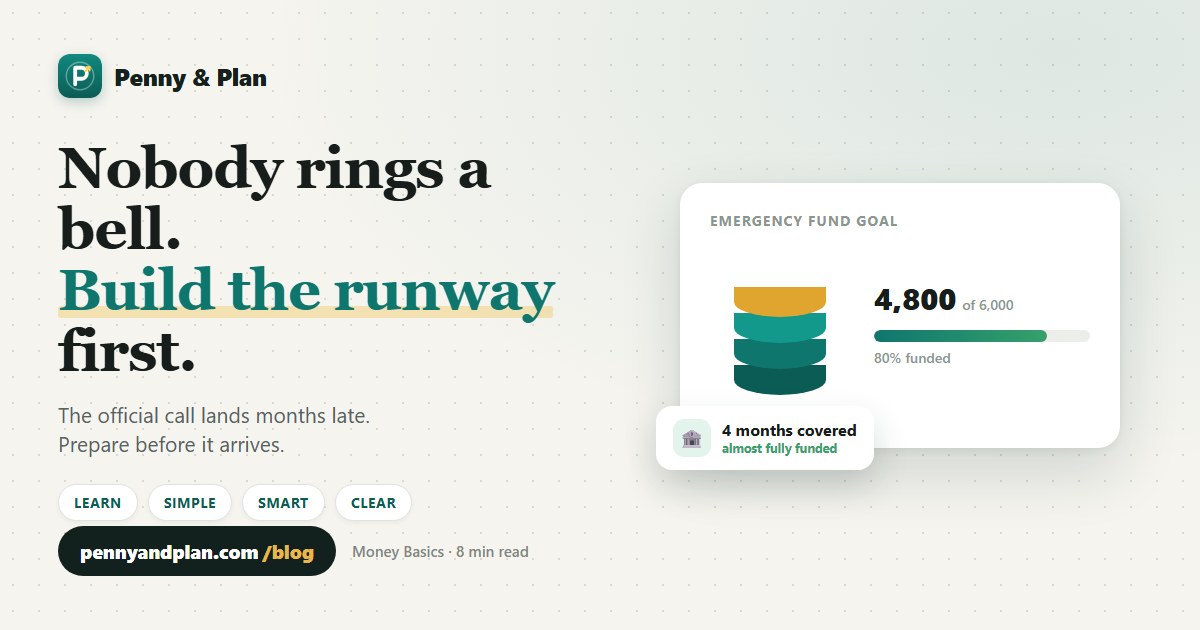
What Is a Recession and How to Prepare for One
Almost everyone waits for a headline. The problem is that the headline is a lagging indicator, and in the US it is not even a headline in the ordinary sense. It is a committee announcement, published well after the downturn it describes began, and often after the worst of it has passed. If your plan is to start preparing when a recession is confirmed, you are planning to start late by design.
So it is worth understanding who actually decides, what they look at, and why none of it helps you as a warning system.
Who calls a recession, and how
The three countries this site covers do it differently, and the difference matters if you read financial news from more than one of them.
| Country | Who dates the downturn | What they look at |
|---|---|---|
| United States | The Business Cycle Dating Committee at the NBER, a private research body | A range of monthly indicators including employment, real personal income less transfers, consumer spending and production, judged on depth, diffusion and duration |
| United Kingdom | No official arbiter; commentators apply the two-quarter convention to ONS data | Quarterly GDP estimates published by the Office for National Statistics, which are revised as more data arrives |
| Canada | The Business Cycle Council convened by the C.D. Howe Institute | Broad measures of output and employment, with dates set retrospectively |
Two things stand out. First, in the US the two-quarter rule is not the definition at all. The NBER explicitly weighs how deep the decline is, how widely it has spread across the economy and how long it has lasted, and it can conclude a recession occurred without the tidy two-quarter pattern. Second, everywhere the dating is retrospective. The starting month or quarter is announced after the fact, sometimes long after.
A third thing is easy to miss: GDP figures get revised. A quarter that first reads as negative can be revised up. Reacting to a first estimate is reacting to a draft.
What a recession actually does to a household
Set aside the aggregate numbers, because they are not what you experience. Four things tend to change at household level, and they arrive in a fairly reliable order.
Hiring slows before firing starts. The first visible sign is usually not layoffs but a quiet freeze: fewer postings in your field, longer interview processes, offers that stall. This is the part that gives you time, and it is the part most people ignore.
Credit gets harder to get. Lenders tighten standards as defaults rise. The practical effect is that the credit line you would have been approved for last year may not be approved this year, and it may not be approved precisely when you need it. This is why the moment to arrange a facility is when you do not need one.
Variable income falls before salaried income does. Commission, overtime, bonuses, freelance work and shift hours all compress early. Households that treat variable income as baseline income feel a downturn long before anyone loses a job.
Asset prices and interest rates move in ways that are not intuitive. Equity markets typically fall in anticipation rather than in response, which is why they often bottom while the news is still bad. Central banks generally cut rates into a weakening economy, which helps borrowers on variable rates and hurts savers.
The number that decides how hard it hits you
You cannot control the cycle. You can control your runway, and runway is one calculation.
Take your essential monthly spending, not your total spending. Then divide your accessible cash by it.
Consider a household bringing home 5,200 a month, in whatever currency applies to you.
| Line | Amount | Notes |
|---|---|---|
| Take-home income | 5,200 | Includes 600 of variable overtime |
| Essential spending | 3,400 | Housing, utilities, food, transport, insurance, minimum debt payments |
| Non-essential spending | 1,100 | Subscriptions, dining out, discretionary shopping |
| Accessible cash | 6,800 | Instant-access savings only |
At full spending, 6,800 divided by 4,500 gives about 1.5 months. On essentials only, 6,800 divided by 3,400 gives exactly 2 months. That is the honest number, and for most households it is lower than they assume, because they measure against total savings including retirement accounts they cannot touch without penalty.
Now work the other direction. Six months of essentials for this household is 20,400, leaving a gap of 13,600. Saving 700 a month closes it in about 20 months. Trimming 250 a month from the non-essential column and directing it to the same place gets there in roughly 14 months instead. Neither is fast, which is the entire argument for starting before anything looks wrong. Our guide to how much emergency fund you actually need goes deeper on sizing that target to your own job security.
One refinement: size the reserve to your re-employment time, not to a generic rule. A nurse and a senior marketing manager on the same salary do not face the same replacement timeline. Specialised and senior roles justify a longer runway.
A staged plan, not a panic
Preparation works better as three tiers than as one big project.
Tier one, do this regardless of the outlook. Get the essentials figure written down, because you cannot plan around a number you have never calculated. Build the first month of runway before anything else. List your fixed costs and cancel what you would not miss. Check that any savings sitting in one institution is within your national deposit protection limit: the FDIC in the US, the FSCS in the UK and CDIC in Canada each publish a current per-person, per-institution limit, and splitting balances across institutions is the fix if you are over it.
Tier two, do this when hiring in your field visibly slows. Refresh your CV or resume before you need it and have one honest conversation with someone in your network each month. Arrange credit while your income still looks strong on paper. Move any money you would need within a year out of volatile assets. Pay down variable-rate and high-interest balances first, since those are the payments that squeeze hardest when income drops. If you are choosing an order to attack them in, our comparison of the snowball and avalanche methods is a useful starting point.
Tier three, do this in the first week of an income loss. File for benefits immediately rather than waiting to see whether you find something, because processing takes time in every one of these systems. Cut the non-essential column to near zero the same week. Contact lenders early: hardship arrangements are far easier to get before a missed payment than after one.
The safety nets differ more than you would expect
This is where generic recession advice fails readers outside the US.
United States. Unemployment insurance is administered state by state under federal guidelines, so the duration, the replacement rate and the eligibility rules genuinely differ depending on where you live. Many states have historically capped regular benefits at 26 weeks, but this is a state decision and some are shorter. Check your own state's programme now, not later. Health coverage is the other US-specific exposure, since coverage tied to employment ends with it, and continuation coverage is usually far more expensive than the payroll-deducted premium you were used to.
United Kingdom. There are two separate things people confuse. New Style Jobseeker's Allowance is contribution-based, depends on your National Insurance record and is not means-tested against savings. Universal Credit is means-tested, and capital above a set threshold generally rules you out altogether, with a lower threshold above which your award starts to taper. That interaction catches people out: building a large cash buffer can reduce what you are entitled to, which is an argument for also reducing fixed costs rather than relying on cash alone.
Canada. Employment Insurance regular benefits pay a share of your average insurable weekly earnings up to an annual maximum, for a number of weeks that varies with your insurable hours and the unemployment rate in your EI region. That regional element is unusual and worth knowing: two people laid off on the same day in different provinces can receive benefits for different lengths of time. EI also requires that you lost the job through no fault of your own, which affects how a voluntary departure is treated.
What to avoid
Three mistakes do most of the damage.
Selling long-term investments to cover short-term bills locks in losses at the worst point, which is what an emergency fund exists to prevent. Taking on a new fixed commitment during a hiring freeze, whether that is a car payment or a larger mortgage, converts flexible income into an inflexible obligation at exactly the wrong moment. And waiting for confirmation, which is where this started, means acting after the credit window has narrowed and the applicant pool has grown.
The bottom line
A recession is a broad, sustained fall in activity, dated after the fact by a committee in the US, by convention against ONS data in the UK, and by the C.D. Howe Business Cycle Council in Canada. None of those bodies will warn you in time, so stop treating the announcement as a trigger. Work out your essential monthly spending, divide your accessible cash by it, and be honest about the number that comes out. Then spend the ordinary months lengthening it, cutting fixed costs and arranging credit you hope not to use. A downturn is far less frightening when the only real question it asks you has already been answered.
Frequently Asked Questions
Is a recession two quarters of negative GDP growth?
That is a widely used shorthand, and in the UK it is the convention most commentators apply to the ONS quarterly GDP figures. It is not the formal definition in the US, where the NBER's Business Cycle Dating Committee weighs several monthly indicators including employment, real personal income and consumer spending, and can date a recession that does not fit the two-quarter pattern. Treat the two-quarter rule as a rough signal rather than a legal test.
How long do recessions usually last?
There is no fixed length, and the range across modern downturns is wide, from a couple of quarters to well over a year. That variability is exactly why planning around a predicted duration is a bad idea. Build a reserve sized to how long it would realistically take you to replace your income in your own field, not to an average recession length.
Should I stop investing during a recession?
Stopping contributions is usually the wrong lever, because it means you sell your future returns to solve a short-term cash problem. Fix the cash problem directly with an emergency fund and reduced fixed costs, and keep automatic contributions running if your income is stable. If your income genuinely stops, pausing contributions is far better than raiding a retirement account and taking the tax hit.
Sources
Primary sources used for this guide. Last checked August 25, 2026.
- Business Cycle DatingNational Bureau of Economic Research
- Gross Domestic Product (GDP)UK Office for National Statistics
- Business Cycle CouncilC.D. Howe Institute
- Unemployment InsuranceUS Department of Labor
- Universal CreditGOV.UK
- EI regular benefitsGovernment of Canada
Keep reading
 Money Basics
What Is Financial Independence and How to Reach It
Financial independence explained: the 25x rule, a savings-rate table, a worked example, and the US, UK and Canada rules that decide when you can spend it.
Money Basics
What Is Financial Independence and How to Reach It
Financial independence explained: the 25x rule, a savings-rate table, a worked example, and the US, UK and Canada rules that decide when you can spend it.
 Money Basics
Needs vs Wants: How to Tell the Difference
A three question test that sorts any purchase into needs or wants, a four tier ranking for tight months, and how the line shifts in the US, UK and Canada.
Money Basics
Needs vs Wants: How to Tell the Difference
A three question test that sorts any purchase into needs or wants, a four tier ranking for tight months, and how the line shifts in the US, UK and Canada.
 Money Basics
What Is Inflation and How Does It Affect Your Money?
Inflation is the rate your money loses buying power. Here is what it does to cash, wages, debt and tax thresholds in the US, UK and Canada, and what helps.
Money Basics
What Is Inflation and How Does It Affect Your Money?
Inflation is the rate your money loses buying power. Here is what it does to cash, wages, debt and tax thresholds in the US, UK and Canada, and what helps.