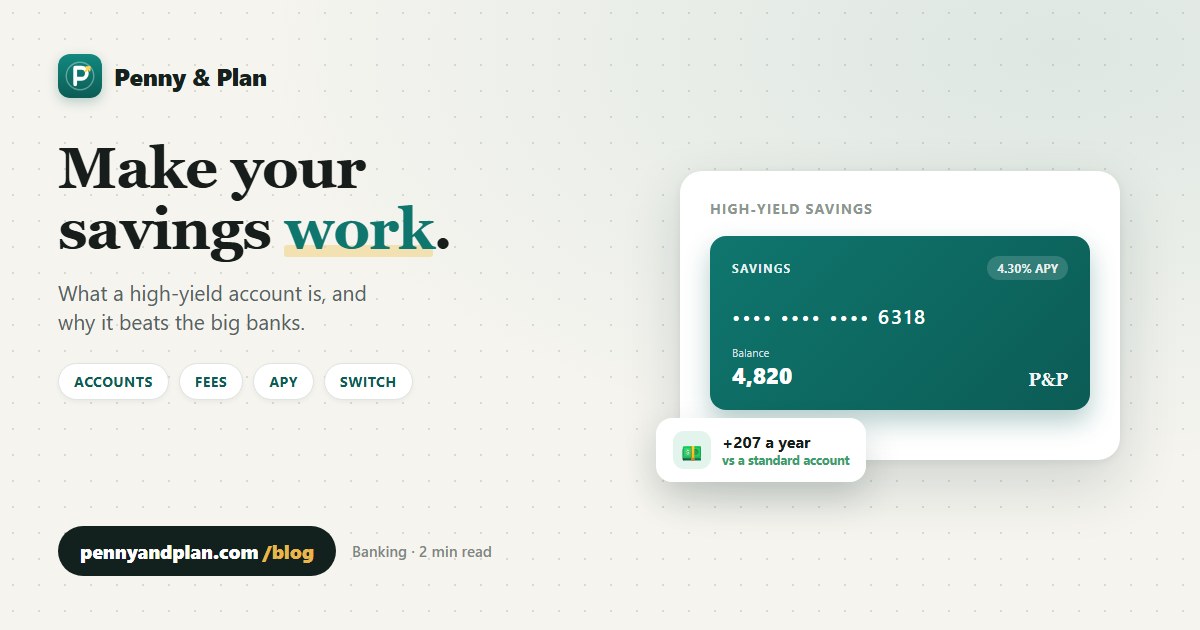
What Is a High-Yield Savings Account? Is It Worth It?
If your savings are sitting in a standard account earning almost nothing, a high-yield savings account is one of the easiest upgrades in personal finance. Here is what it is, whether it is safe, and how to choose one.
What it actually is
A high-yield savings account is simply a savings account that pays a much higher interest rate than a typical high-street or big-bank savings account. The difference can be large: where a standard account might pay a tiny fraction of a percent, a high-yield account can pay many times more.
Everything else works the way you expect. You deposit money, it earns interest, and you can withdraw it. The account just pays you meaningfully more for keeping your money there.
Why the rates are higher
High-yield accounts are often offered by online banks and providers with lower overheads than traditional branch-based banks. They pass some of those savings on as higher interest to attract deposits. It is genuine competition, not a gimmick.
Is it safe?
For most people, yes. The key is deposit protection. When your provider is covered by your country's government-backed deposit protection scheme, your money is protected up to the scheme's limit even if the bank fails.
So a high-yield account at a covered bank is just as safe as a regular savings account at a covered bank. The higher rate does not mean higher risk. Always confirm the provider is covered and note the protection limit.
The trade-offs to check
High-yield accounts are excellent, but read the terms:
- Introductory rates. Some pay a high rate for a few months, then drop. Know what the rate becomes.
- Conditions. A few require a minimum balance, regular deposits, or limit how often you can withdraw.
- Access. Most give access within a day or two. If you need instant access, confirm that.
- Online-only. Many are app or web based with no branches. Fine for most people, but worth knowing.
Where it fits in your money
A high-yield savings account is ideal for money you want safe and accessible, such as:
- Your emergency fund
- Short-term goals like a holiday or house deposit within a few years
- Cash buffers you do not want exposed to market ups and downs
For very long-term money, investing may grow faster over time, but for safety-first savings, high-yield accounts are hard to beat.
The bottom line
A high-yield savings account pays much more interest than a standard account while staying safe at a deposit-protected bank and keeping your money accessible. Check the rate, any conditions, the deposit protection and the access terms, then move your emergency fund and short-term savings across. It is one of the simplest ways to make your existing money work harder without taking on real risk.
Frequently Asked Questions
Is a high-yield savings account safe?
Yes, when the provider is covered by your country's deposit protection scheme, your money is protected up to the scheme limit even if the bank fails. High-yield accounts carry the same protection as regular savings accounts at covered banks, so the higher rate does not mean higher risk.
What is the catch with high-yield savings accounts?
There is rarely a real catch, but watch for conditions: some require a minimum balance, limit withdrawals, offer an introductory rate that later drops, or are online-only. Read the terms so the headline rate is one you will actually keep earning.
Can I lose money in a high-yield savings account?
Not in nominal terms at a deposit-protected bank; your balance does not fall. The main risk is that inflation can outpace the interest, reducing what your money can buy. For short-term savings and emergency funds, that trade-off is usually acceptable in exchange for safety and access.
Keep reading
 Banking
Debit Card vs Credit Card: Which Should You Use?
Debit card vs credit card explained simply, the real pros and cons, when to use each, and how to get card rewards without paying interest.
Banking
Debit Card vs Credit Card: Which Should You Use?
Debit card vs credit card explained simply, the real pros and cons, when to use each, and how to get card rewards without paying interest.
 Subscriptions
How Much Does YouTube Premium Cost? Is It Worth It?
YouTube Premium prices went up in 2026. Here is what every plan costs, how the US, UK and Canada compare, and whether it is worth paying for each month.
Subscriptions
How Much Does YouTube Premium Cost? Is It Worth It?
YouTube Premium prices went up in 2026. Here is what every plan costs, how the US, UK and Canada compare, and whether it is worth paying for each month.
 Subscriptions
How to Cancel Audible and Keep Your Books
Cancelling Audible does not delete your audiobooks, but it does wipe your unused credits. Here is how to cancel properly and keep everything you paid for.
Subscriptions
How to Cancel Audible and Keep Your Books
Cancelling Audible does not delete your audiobooks, but it does wipe your unused credits. Here is how to cancel properly and keep everything you paid for.