What Is APY and How Is It Calculated?
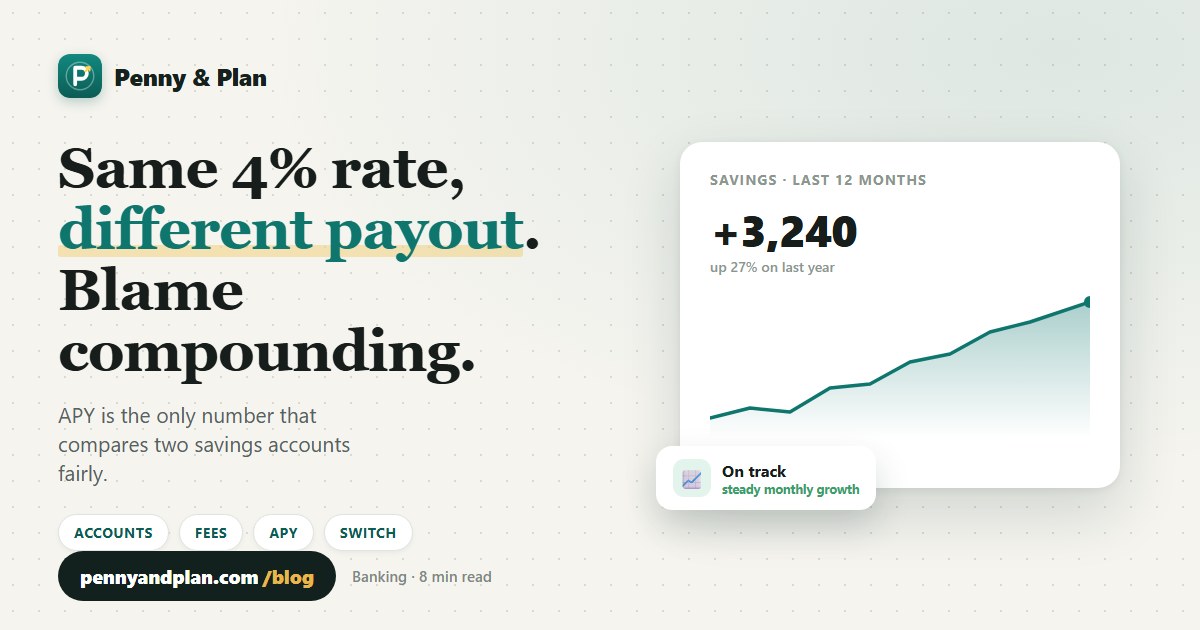
Here is a small puzzle that decides where a lot of savings money should live. Account A advertises 4.00 percent. Account B advertises 3.95 percent. Account A pays interest once a year, Account B pays it daily. Which one leaves you with more money in twelve months?
Account B does, and the number that would have told you so instantly is the APY.
The formula, in one line
APY stands for annual percentage yield. It answers a single question: if I leave money in this account untouched for a year, what percentage will I actually have gained once the interest starts earning interest of its own?
The maths is short:
APY = (1 + r/n)^n - 1
where r is the nominal annual interest rate as a decimal, and n is how many times a year the account compounds. At 4 percent compounded monthly, that is (1 + 0.04/12)^12 - 1, which comes out at 4.074 percent.
US banks do not get to choose their own version of this. Regulation DD, which implements the Truth in Savings Act, prescribes the calculation in an appendix, and the general form is APY = 100 [(1 + Interest/Principal)^(365/Days in term) - 1]. The point of a mandated formula is comparability. Whatever a bank calls its account, the APY on the disclosure was produced the same way as every competitor's, which is what makes it worth reading.
What that actually looks like on real money
Take $10,000 sitting at a nominal 4.00 percent for a full year, and change nothing except how often the interest is added.
| Compounding | Effective APY | Interest after one year |
|---|---|---|
| Annually | 4.000% | $400.00 |
| Quarterly | 4.060% | $406.04 |
| Monthly | 4.074% | $407.42 |
| Daily | 4.081% | $408.08 |
The whole spread from worst to best is $8.08.
That figure is worth sitting with, because compounding frequency is marketed far more aggressively than it deserves. Now run the original puzzle: 3.95 percent compounded daily produces an APY of 4.029 percent, or $402.88, which beats the 4.00 percent annual account by $2.88. Compounding won that one. But drop the headline rate a little further, to 3.90 percent compounded daily, and you get $397.68, which loses to plain annual compounding at 4.00 percent.
The practical rule falls straight out of the table. A 0.10 percentage point improvement in the headline rate is worth more than any possible upgrade in compounding frequency. Chase the rate first, treat daily compounding as a tiebreaker, and ignore anyone selling it as the main event. If the mechanics of that snowball still feel abstract, our explainer on compound interest walks through the same idea over decades rather than months.
Rate, APY and APR are three different animals
These get used interchangeably in conversation and they should not be.
| Term | Applies to | Includes compounding? | What it is for |
|---|---|---|---|
| Nominal interest rate | Deposits and loans | No | The raw rate applied each period |
| APY | Deposits | Yes | Comparing what savings accounts pay you |
| APR | Loans and credit | Generally not, but may include fees | Comparing what borrowing costs you |
The asymmetry is deliberate and it works against you twice. On savings, the figure quoted includes compounding, so it flatters the product. On borrowing, the figure quoted often excludes it, so a credit card at 24 percent APR costs more than 24 percent over a year if you revolve a balance, because the interest charged in January is itself earning the lender interest by March.
There is also a fourth number that appears on US statements: annual percentage yield earned. That one is backward-looking, calculated on the interest you actually received over your actual average daily balance during the statement period. If it sits well below the advertised APY, something is eating the difference, usually a fee or a balance that dipped below a tier threshold.
The same idea has three different names
United States. APY, mandated by Regulation DD for depository institutions, must appear in account disclosures and in most rate advertising. Tiered accounts have to show the APY for each tier, which matters because "up to 4.50%" often means 4.50 percent on the first few thousand dollars and something far duller above it.
United Kingdom. The equivalent figure is the AER, the annual equivalent rate, and FCA rules require it wherever an interest-bearing account is advertised so that products are comparable on a like-for-like basis. UK accounts also quote a gross rate, which is the rate before tax and before any compounding of interest paid away to another account. Two extra habits are worth knowing. Introductory bonus rates are extremely common, and the advertised AER usually includes a bonus that expires after twelve months, so the rate you are quoted is not the rate you will hold in month thirteen. And since 2016, UK banks pay interest gross with no tax deducted at source, so the AER you see is your pre-tax return with nothing withheld.
Canada. There is no single mandated APY-equivalent label for deposit accounts in the way the US has one. Canadian banks quote an annual interest rate and separately state how interest is calculated, and the near-universal convention on high-interest savings accounts is that interest is calculated daily on the closing balance and paid monthly. That is effectively monthly compounding, so the true annual yield sits slightly above the quoted rate. Promotional rates for new deposits are heavily used here too, typically running three to six months before reverting. GICs are the fixed-term comparison: a compound GIC reinvests interest and quotes an annual rate, while an annual-pay GIC hands the interest to you, and the two produce different totals from the same headline number.
What APY quietly leaves out
The formula only knows about interest. Everything else is on you.
- Fees. A monthly maintenance charge is not in the APY. On a $2,000 balance, one $5 monthly fee costs $60 a year, which is more than the entire 4 percent of interest you were chasing. Fee-free accounts matter more than rate at small balances, which is the core of choosing the right bank account in the first place.
- Variability. Savings APYs are not promises. They move when central bank rates move, and often faster on the way down than on the way up.
- Balance caps and tiers. Headline rates are frequently capped at a set balance, with the remainder earning a fraction of it.
- Conditions. Minimum monthly deposits, a required number of card transactions, or limits on withdrawals per month are common on the highest-paying accounts. Miss the condition and the rate for that month collapses.
- Overdrafts and other charges elsewhere at the same bank. A great savings APY at an institution whose current account stings you is a net loss. Our guide to overdraft fees covers what to look for.
A sixty-second check before you open anything
Do these four things in order and you will beat most rate-chasing.
- Read the APY or AER, not the "interest rate" in the headline. If only a nominal rate is shown, find the compounding frequency and run the formula yourself.
- Find the expiry date on any bonus or promotional element, and diarise it.
- Look for the balance cap and the tier table, then check what your actual balance would earn rather than what the first tier earns.
- Confirm the institution is covered: FDIC insurance in the US at $250,000 per depositor, per insured bank, per ownership category, or NCUA cover for credit unions; FSCS protection in the UK at £85,000 per person per authorised firm; CDIC coverage in Canada at $100,000 per insured category per member institution. An unusually high rate at an uninsured platform is not a better deal, it is a different product.
Tax makes the APY smaller than it looks
APY is always quoted pre-tax, and the gap between headline and take-home differs sharply by country.
In the US, interest is taxed as ordinary income at your marginal rate, and banks issue a Form 1099-INT once you earn $10 or more in a year. A 4.00 percent APY for someone in the 24 percent federal bracket is closer to 3.04 percent after federal tax, before any state tax.
In the UK, the Personal Savings Allowance lets basic rate taxpayers earn £1,000 of interest tax free and higher rate taxpayers £500, while additional rate taxpayers get nothing. Interest inside a cash ISA is outside all of this and is tax free regardless of amount, which is why the correct comparison is often ISA AER against taxable AER after your allowance is used up, not one headline against another.
In Canada, interest is fully included in income and taxed at your marginal rate with no equivalent allowance, which makes it the least tax-efficient form of investment income in the country. Interest earned inside a TFSA is tax free, so filling that room before holding cash in a taxable account is usually the first move. Report interest even in years when no T5 slip arrives, because the reporting threshold is lower than the filing obligation.
If you are comparing accounts at this level of detail, it is worth reading how high-yield savings accounts fit alongside the rest of your cash.
The bottom line
APY is the honest version of a savings rate: the same interest rate with compounding already counted, calculated the same way across every provider so the comparison is real. Use it, but use it knowing what it excludes. Chase the headline rate first, treat compounding frequency as the tiebreaker it is, check the bonus expiry and the balance cap, subtract every fee, and remember that the number on the advert is the number before your tax authority takes a share.
Frequently Asked Questions
Is APY the same as interest rate?
No. The interest rate is the nominal figure applied to your balance each period. APY takes that rate and adds the effect of earning interest on your interest during the year. If an account compounds only once a year the two numbers are identical, and for every other compounding frequency the APY is slightly higher than the nominal rate.
What is the difference between APY and APR?
APY describes what you earn on deposits and includes compounding. APR describes what you pay on borrowing and, in most consumer disclosures, does not compound in the same way, though it can include certain loan fees. A credit card quoting a 24 percent APR actually costs more than 24 percent a year if you carry a balance, because interest is charged monthly on a growing total.
Can a bank change the APY after I open the account?
On an ordinary savings or money market account, yes. Those rates are variable and can move at any time, usually with little or no notice. Fixed-term products such as US certificates of deposit, UK fixed-rate bonds and Canadian non-redeemable GICs lock the rate for the term, which is the trade-off you accept in return for giving up access to the money.
Sources
Primary sources used for this guide. Last checked August 12, 2026.
- 12 CFR Part 1030, Truth in Savings (Regulation DD)US Electronic Code of Federal Regulations
- Topic no. 403, Interest receivedUS Internal Revenue Service
- Deposit InsuranceUS Federal Deposit Insurance Corporation
- Tax on savings interestGOV.UK
- Banks and building societies: what we coverFinancial Services Compensation Scheme
- What's coveredCanada Deposit Insurance Corporation
Keep reading
 Banking
How to Avoid Bank Fees Completely
Count what your bank charges you in a year, then remove each fee at the source, using the free-account rules that exist in the US, UK and Canada.
Banking
How to Avoid Bank Fees Completely
Count what your bank charges you in a year, then remove each fee at the source, using the free-account rules that exist in the US, UK and Canada.
 Banking
What Is a Certificate of Deposit (CD)?
A certificate of deposit locks money for a fixed term at a fixed rate. How the penalty math works, when to break one, and how the US, UK and Canada differ.
Banking
What Is a Certificate of Deposit (CD)?
A certificate of deposit locks money for a fixed term at a fixed rate. How the penalty math works, when to break one, and how the US, UK and Canada differ.
 Banking
How to Choose the Right Bank Account
Compare bank accounts on the four things that actually matter: fees, rate, access and deposit protection, plus the US, UK and Canada rules most guides skip.
Banking
How to Choose the Right Bank Account
Compare bank accounts on the four things that actually matter: fees, rate, access and deposit protection, plus the US, UK and Canada rules most guides skip.