The Cash Envelope System Explained
The cash envelope system is the oldest budgeting method still in use, and it survives for one reason: an empty envelope is impossible to argue with. An app can tell you that you are over budget. Cash simply stops.
What the system actually is
You take your spending money out in cash on payday, split it across labelled envelopes, and spend each category only from its own envelope. Groceries come out of the groceries envelope. When that envelope is empty, groceries stop until the next payday.
The critical detail that most explanations skip: envelopes are only for flexible spending. Rent or mortgage, utilities, insurance, loan repayments, subscriptions and anything else on a fixed schedule stays exactly where it is, paid from your account by direct debit or pre-authorized payment. Trying to put your rent in an envelope is how people end up with a late fee and a drawer full of cash.
So the money splits three ways:
- Fixed bills stay in the account and pay themselves.
- Savings move out on payday, before you see the rest.
- Everything left is what gets divided into envelopes.
Why it works when apps do not
Budgeting apps fail quietly. You overspend on a Tuesday, the app updates a bar chart, and nothing physically stops. Cash creates friction at the exact moment the decision is made, and that friction is the whole product. Handing over notes and watching the envelope thin out is a slower, more deliberate act than tapping a card, and researchers in behavioural economics have long argued that the more transparent the payment method, the more the spending is felt.
There is a second effect that gets less attention. Envelopes force you to decide your priorities once a month, calmly, at the kitchen table, instead of forty times a month in a shop while you are tired. The decision is front-loaded, and front-loaded decisions are better ones.
Setting it up in one evening
Step one: work out one month of real spending. Not what you think you spend. Pull three months of statements and average the flexible categories. The CFPB, MoneyHelper and the Financial Consumer Agency of Canada all publish free budget worksheets that do this for you, and using one is faster than building your own spreadsheet.
Step two: pick four or five envelopes. Not twelve. Too many envelopes is the number one reason people quit.
Step three: name the amount, then withdraw it. One withdrawal per payday, in the notes you actually need. Ask for smaller denominations, because a single large note tends to get broken and then vanish.
Step four: leave a buffer in the account. Keep a small cushion for the bills so nothing bounces while your spending cash sits in envelopes.
Here is a starting structure that works for most households.
| Envelope | What goes in it | Typical rule |
|---|---|---|
| Groceries | Supermarket, butcher, market | The biggest envelope, refill weekly not monthly |
| Eating out | Restaurants, takeaway, coffee | The one that changes behaviour fastest |
| Fuel or transport | Petrol, transit passes, parking | Fixed amount, refill only on payday |
| Personal or fun | Clothes, hobbies, treats | One per adult, no questions asked |
| Household extras | Cleaning, small repairs, pet supplies | Rolls over if unspent |
A weekly refill on groceries is worth doing even if you get paid monthly. A month of grocery money in one envelope on day one leads to a generous first week and a lean fourth.
What to do when an envelope runs out
The honest answer is the one nobody likes: you stop. That is the mechanism working, not the system failing.
If you genuinely have to move money, the rule is to move it between envelopes, never to top up from the account. Take it from the fun envelope and write on the front of the groceries envelope where it came from. Two things follow from that discipline. First, you feel the trade instead of ignoring it. Second, after two or three cycles you have a written record of which envelope was always short, which tells you exactly what to adjust next month.
Leftover cash is also a decision. Pick one policy and stick to it: roll it forward into the same envelope, sweep it into savings, or sweep it against debt. Sweeping to debt or savings on the same day every month is what turns the envelope system from a spending control into an actual wealth-building habit.
The digital envelope system
Cash use has fallen sharply across all three countries, and in parts of the UK in particular a card-only cafe or shop is now completely normal. That does not kill the method. It just moves it.
Most modern banking apps ship the same idea under a different word. UK app banks popularised pots and spaces, and several let you assign a card or a specific direct debit to a named pot, so the limit is enforced when you pay. In the US, many banks and credit unions allow multiple free sub-accounts or savings buckets, and some checking accounts let you separate balances by goal. In Canada, no-fee online banks generally allow several accounts under one login, and Interac e-Transfer makes moving money between them instant.
The rule that decides whether a digital envelope works is simple: the money must actually be separated, not just labelled. A spreadsheet that says groceries is at 60 percent while all the money still sits in one balance is a report, not an envelope. If the balance you spend from does not visibly shrink to zero, you have rebuilt the app that already failed you.
A middle path suits a lot of people. Keep cash envelopes for the two or three categories where you overspend, usually eating out and personal spending, and keep everything else on card. You get the friction where it matters without hunting for a cash machine every week.
Where the system falls down
It is worth being straight about the trade-offs.
- Cash that is lost or stolen is gone. Money in an insured bank account is protected up to the relevant national limit. Cash in a kitchen drawer is not protected by anything. Do not keep large amounts at home.
- You forgo card protections and rewards. Card payments come with chargeback and fraud protections that cash does not have, and paying cash means no cashback or points.
- It does nothing for your credit file. If you are trying to build credit history, running everything in cash will not help. A common fix is to spend from the envelope amount on a card and immediately move that exact sum to the account, so the card is cleared in full every month.
- Online spending needs its own envelope. Subscriptions and online shopping cannot take notes, so give them a named digital pot instead.
- It is admin. One withdrawal and a ten minute sort each payday. If that is the part you skip, go digital from the start.
The bottom line
The cash envelope system is not about cash. It is about making a spending limit real enough that it stops you at the till rather than reporting on you afterwards. Start with four envelopes, fund the flexible categories only, refill groceries weekly, and pick one rule for leftovers. Whether the envelopes are paper or pots inside your banking app matters far less than whether the money genuinely runs out.
Frequently Asked Questions
How many envelopes should I have?
Four or five to start. Groceries, eating out, fuel or transport, and a general fun or personal envelope covers most households. You can add more later, but too many envelopes on day one is the single most common reason people abandon the system in week two.
What if an envelope runs out before payday?
The intended answer is that you stop spending in that category. If you must move money, take it from another envelope rather than adding new money, and write down where it came from. Repeatedly raiding the same envelope is a signal that your original amount was set too low, not that the system failed.
Does the envelope system still work if I never use cash?
Yes. Digital envelopes work the same way if the balance is genuinely separated rather than just labelled. Many banks in the US, UK and Canada offer pots, spaces, vaults or sub-accounts, and some let you attach a card to a specific pot so the limit is enforced at the till.
Sources
Primary sources used for this guide. Last checked August 6, 2026.
- Budgeting: How to create a budget and stick with itConsumer Financial Protection Bureau
- Your Money, Your Goals toolkitConsumer Financial Protection Bureau
- Spend: MyMoney FiveMyMoney.gov (US Financial Literacy and Education Commission)
- Managing Your MoneyUS Federal Trade Commission (consumer.gov)
- Budget plannerMoneyHelper (UK)
- Make a budgetFinancial Consumer Agency of Canada
Keep reading
 Budgeting
How to Budget as a Couple Without Arguing
The three ways couples can structure money, the monthly meeting that stops the same fight repeating, and the tax breaks partners in the US, UK and Canada miss.
Budgeting
How to Budget as a Couple Without Arguing
The three ways couples can structure money, the monthly meeting that stops the same fight repeating, and the tax breaks partners in the US, UK and Canada miss.
 Budgeting
How to Budget on an Irregular or Variable Income
A practical system for budgeting on a variable income: find your floor, pay yourself a steady salary, and stay ahead of tax bills in the US, UK and Canada.
Budgeting
How to Budget on an Irregular or Variable Income
A practical system for budgeting on a variable income: find your floor, pay yourself a steady salary, and stay ahead of tax bills in the US, UK and Canada.
 Budgeting
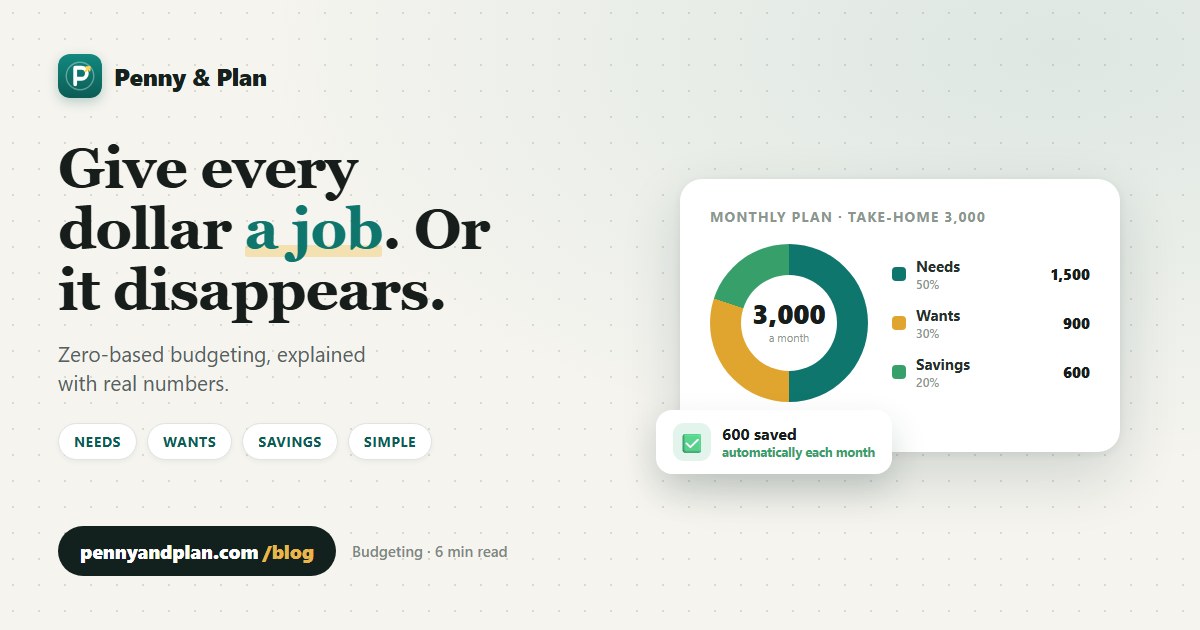
Zero-Based Budgeting Explained With Examples
How zero-based budgeting works, worked examples for steady and irregular income, and the free official tools that make it take an hour instead of a weekend.
Budgeting
Zero-Based Budgeting Explained With Examples
How zero-based budgeting works, worked examples for steady and irregular income, and the free official tools that make it take an hour instead of a weekend.