How to Ask for a Pay Raise (and Get It)
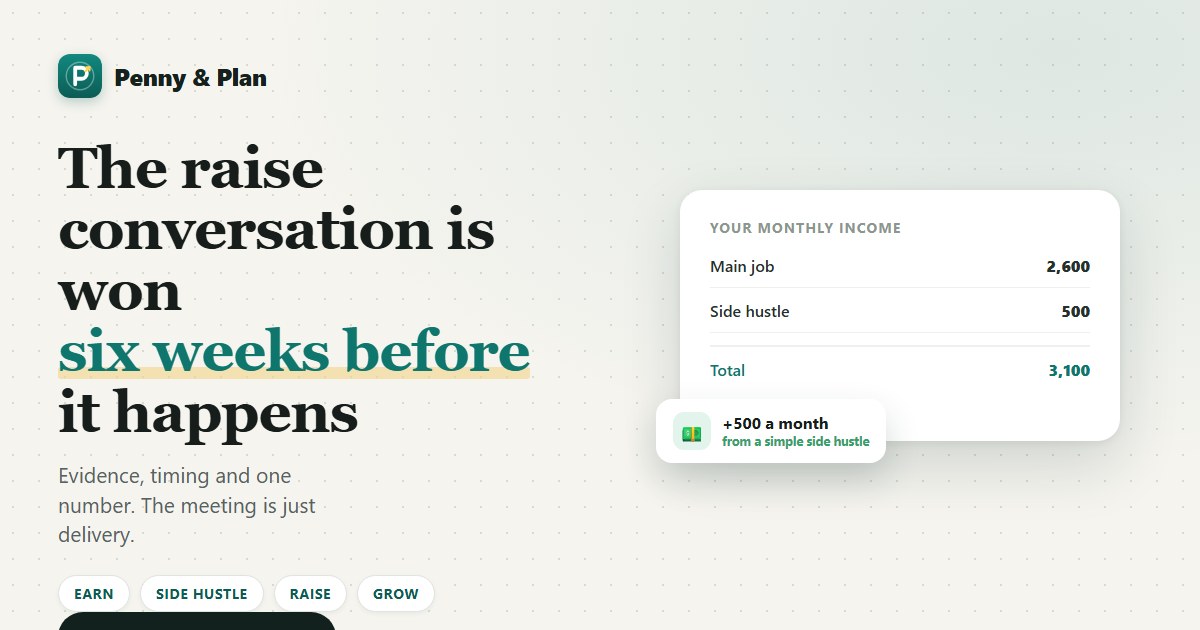
Most people treat asking for a raise as a single brave conversation. It is not. By the time you are sitting in the meeting, roughly eighty percent of the outcome is already decided, by when you asked, what evidence you brought, and whether your number is anchored to anything a manager can defend upwards. The conversation is delivery. The work happens in the six weeks before it.
Start with what the raise is actually worth
The reason to do this properly is that raises compound and nothing else in your household finances moves this much money for this little effort.
Take someone on 60,000 who is due nothing this year but could realistically make the case for 10 percent. Compare two versions of the next decade, both assuming the same 3 percent annual increases afterwards.
In year one the gap is 6,000. But every subsequent increase is applied to the higher base, so the gap grows about 3 percent a year too. Over ten years the cumulative difference is just under 69,000, before you count anything else.
And there is something else. Percentage-based employer contributions ride along with the base. A 401(k) match, a UK workplace pension contribution, an RRSP match, employer life cover, bonus targets expressed as a percentage of salary: all of them are calculated off the number you negotiate once. That is why a single successful conversation outperforms almost any side income you could start from home, and why it is worth six weeks of preparation rather than an anxious afternoon.
Ask before the budget exists, not after
This is the mistake that quietly kills most well-argued requests.
Salary budgets are set once a year, usually one to three months before the organisation's financial year end, and then distributed. If you ask in month two of the new year, your manager is not weighing your case against nothing. They are trying to find money that has already been allocated to other people. Even a manager who fully agrees with you is now negotiating on your behalf against a fixed pot, and they will usually lose.
Find out when your employer's financial year ends and when pay decisions are made. Ask a friendly colleague, or ask your manager directly in a low-stakes moment: "When in the year do salary decisions actually get made here?" Then plan to have your conversation four to eight weeks before that.
A strong delivery moment helps, but it is a secondary trigger. A brilliant case made in the wrong month loses to an average case made in the right one.
Build a file, not an argument
Between now and the meeting, keep a running note of your work. Not a feelings document, a file a manager could forward upwards without editing.
The test for anything you include is simple: could someone who does not like you verify it? "I led the migration" fails. "I led the migration, it shipped three weeks early, and support tickets in that area fell from about forty a month to under ten" passes.
Aim for six to eight items, weighted toward the last twelve months, and covering three types:
Things you delivered. Projects finished, revenue influenced, costs removed, time saved. Numbers where you have them, and a named colleague who saw it where you do not.
Ways the job grew. This is the strongest category and the one people forget. If you now manage people, own a system, cover a region, or handle work that used to belong to someone more senior, your job title is describing a job you no longer have. That is not a request for a reward, it is a request to be paid for the role you are actually doing.
Things that would be expensive to replace. Relationships, system knowledge, the fact that you are the only person who understands a particular process. State this factually. Never as a threat.
Find the number before you name one
Your rent going up is not an argument. Your market rate is. Every one of these countries publishes free official wage data, and it is far more persuasive in a meeting than a salary site your manager can dismiss as crowdsourced.
| Country | Official source | What it gives you |
|---|---|---|
| United States | Bureau of Labor Statistics occupational wage data, signposted from the Department of Labor | Median and percentile wages by occupation and metro area |
| United Kingdom | ONS earnings and working hours releases, including the annual survey of hours and earnings | Median and distribution of gross pay by occupation and region |
| Canada | Job Bank wage search, run by the Government of Canada | Low, median and high hourly wages by occupation and province or region |
Use the percentile data, not just the median. If the median for your occupation and region is 70,000 and the upper quartile is 84,000, you now have a defensible ladder rather than a single point, and your evidence file is the argument for where on that ladder you sit.
Then pick one specific figure and set it slightly above your real target. If you would be happy at 66,000, ask for 68,500. Do not offer a range, because an employer hears the bottom of a range and treats it as your ask.
The meeting
Request it in advance and say what it is about. Ambushing your manager gets you a defensive answer and a "let me think about it" that never returns.
Open by naming the purpose in one sentence, then make the case in about ninety seconds: what you have delivered, how the job has changed, what the market pays for it. Then say the number, plainly, and stop.
The silence after your number is the whole negotiation. It is uncomfortable for about four seconds, and most people fill it by talking themselves downwards. Do not. Let your manager respond first.
Expect one of three answers. If it is yes, ask when it takes effect and get it in writing. If it is a counter, treat it as a starting point rather than a verdict. If it is "I'll need to check", ask what they need from you and agree a date, then send a short summary email the same day so your case exists on paper when the budget conversation happens without you in the room.
When the answer is no
Do not let a no stay vague, because vague nos repeat forever.
Ask the question that forces specifics: "What would need to be true for this to be a yes?" Then write down the answer, send it back to your manager, and agree a date to revisit, ideally three to six months out.
You also have non-cash levers, and they are often easier to say yes to than salary because they come out of a different budget or none at all. A title change that raises your market value. A training or certification budget. A one-off bonus when the salary line is frozen. In the UK, all employees have the right to request flexible working, and a compressed or remote arrangement has real monetary value in commuting costs and childcare.
If the same conversation happens twice with nothing changing, the raise probably does not exist at that employer, and that is worth knowing early rather than late.
What the law gives you, by country
Your leverage is partly legal, and it differs sharply.
United States. There is no federal requirement to publish pay, but a growing number of states, including California, Colorado, New York and Washington, require pay ranges in job advertisements, which makes external postings for your own role a legitimate benchmark. The Equal Pay Act, enforced by the EEOC, prohibits unequal pay for substantially equal work on the basis of sex. Separately, the National Labor Relations Act protects most private sector employees who discuss their pay with colleagues, so a workplace policy telling you never to talk about salary is generally unenforceable.
United Kingdom. Acas publishes free, practical guidance on pay and wages that is worth reading before you ask. Under the Equality Act 2010, pay secrecy clauses cannot be used to stop colleagues discussing pay where the purpose is to find out whether there is discrimination. Employers with 250 or more employees must publish gender pay gap figures, which are public and can be a legitimate part of your case. And the right to request flexible working applies from day one of employment.
Canada. The federal Pay Equity Act requires federally regulated employers above a size threshold to maintain a proactive pay equity plan, and equal pay for work of equal value is protected across jurisdictions. British Columbia's pay transparency legislation requires expected pay or a pay range in publicly advertised jobs, and other provinces have been moving in the same direction, so check your own province's current rules before you benchmark.
The bottom line
Find out when the salary budget is set and work backwards from there. Spend the weeks in between building a file of things someone else could verify, especially evidence that the job has grown beyond its title. Get your number from official wage data for your occupation and region, add a margin, and name one specific figure. Then say it and stop talking. Do that once a year and the compounding does more for your finances than almost anything else you could spend six weeks on.
Frequently Asked Questions
How much of a raise should I ask for?
Work out the market range for your occupation and region from official wage data, decide where in that range your evidence puts you, and ask for slightly more than that so there is room to settle. In practice most internal raise requests land between about 5 and 15 percent, with the higher end reserved for people whose job has genuinely grown or who are demonstrably below the market rate. Ask for a specific figure rather than a range, because an employer will always hear the bottom of a range.
When is the best time to ask for a raise?
Ask in the weeks before your employer decides next year's salary budget, which is usually one to three months before your organisation's financial year end. Once the budget is fixed, even a manager who agrees with you has nothing left to allocate. A strong delivery moment, such as finishing a project that mattered, is a good trigger, but the budget calendar matters more.
What should I do if my raise request is refused?
Do not accept a vague no. Ask what specifically would need to change for the answer to be yes, get that written down, and agree a date to revisit it, ideally within three to six months. If the answer involves things outside your control, or the same conversation repeats twice with nothing changing, that is useful information about whether the raise exists at this employer at all.
Sources
Primary sources used for this guide. Last checked August 26, 2026.
- WagesUS Department of Labor
- Equal Pay and Compensation DiscriminationUS Equal Employment Opportunity Commission
- Pay and wagesAcas
- Earnings and working hoursUK Office for National Statistics
- Search wages by occupationJob Bank, Government of Canada
- Pay equityEmployment and Social Development Canada
Keep reading
 Income
How to Turn a Hobby Into Extra Income
The three assets a hobby can sell, a worked example with fees and hours taken out, and where the hobby/business tax line sits in the US, UK and Canada.
Income
How to Turn a Hobby Into Extra Income
The three assets a hobby can sell, a worked example with fees and hours taken out, and where the hobby/business tax line sits in the US, UK and Canada.
 Income
How to Negotiate a Job Offer
How to buy time on an offer, price the whole package rather than the base, counter once with a real number, and what changes in the US, UK and Canada.
Income
How to Negotiate a Job Offer
How to buy time on an offer, price the whole package rather than the base, counter once with a real number, and what changes in the US, UK and Canada.
 Income
How to Start Freelancing With No Experience
The experience paradox is really a proof problem. Here is the 30-day build, the pricing arithmetic beginners get wrong, and the paperwork in the US, UK and Canada.
Income
How to Start Freelancing With No Experience
The experience paradox is really a proof problem. Here is the 30-day build, the pricing arithmetic beginners get wrong, and the paperwork in the US, UK and Canada.