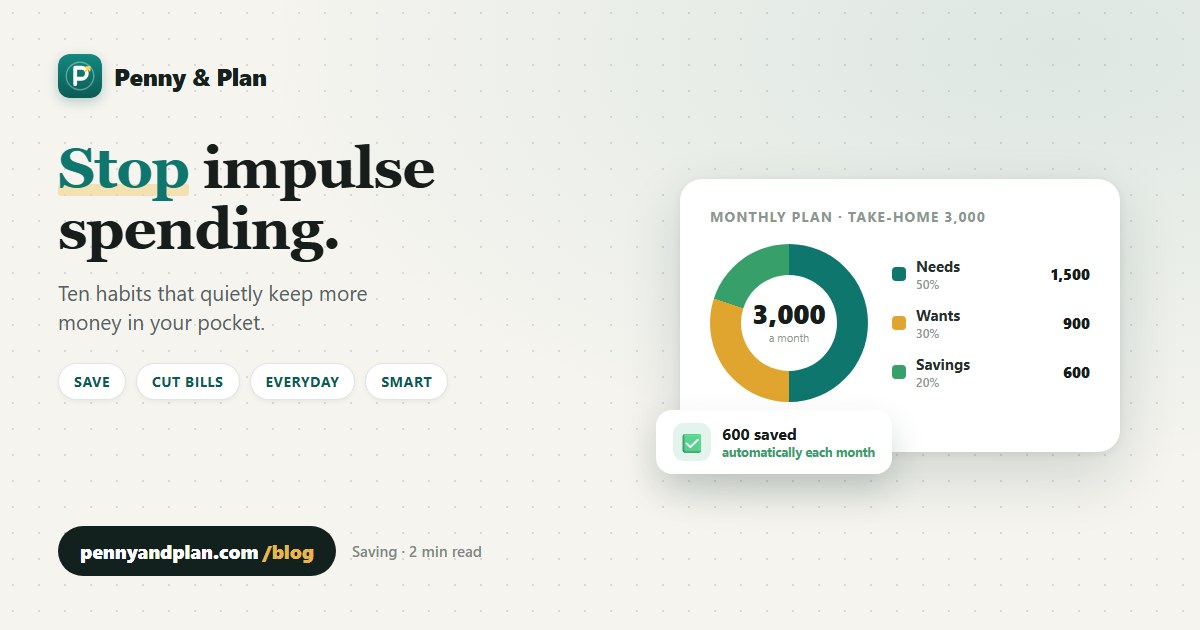
How to Stop Impulse Spending: 10 Habits That Work
Impulse spending is rarely about needing things. It is about emotion, convenience and clever marketing catching you at the right moment. Retailers spend enormous effort removing every second of friction between wanting something and paying for it, from one-click checkout to saved cards to "only 2 left" countdown timers. The solution is not more willpower, because willpower loses to a well-designed checkout every time. The solution is designing your own habits so impulse buys become harder and rarer. Here are ten that work.
Why impulse buying happens in the first place
It helps to understand what you are up against. An impulse purchase is an emotional decision your rational brain only gets to review after the money has gone. Marketing is built to exploit that gap: scarcity messages create urgency, "buy now pay later" hides the true cost, and free next-day delivery removes the last excuse to wait. Regulators have started to push back. In the UK, the Financial Conduct Authority has been bringing buy-now-pay-later products under tighter oversight, and consumer bodies like the Consumer Financial Protection Bureau in the US and the Financial Consumer Agency of Canada all warn that these frictionless credit options make overspending easier. Every habit below works by putting time or friction back into a process that has been deliberately engineered to remove both.
Add time before you buy
1. Use the 24-hour rule. For any non-essential purchase, wait a day. For bigger items, wait 30 days. Most urges fade, and the ones that survive are usually genuine wants rather than whims.
2. Keep a wish list. When you want something, add it to a list instead of buying. Revisit it later. You will be surprised how often the desire has passed on its own.
3. Ask three questions. Do I need it? Would I buy it at full price? Where will it live? Hesitation on any of these is a signal to wait.
Add friction to the process
4. Remove saved cards. Deleting stored card details from shops and browsers means every purchase requires digging out your card, just enough effort to break autopilot.
5. Unsubscribe from marketing emails. Sales you never hear about cannot tempt you. Unsubscribe ruthlessly from retailer newsletters, and treat every "last chance" subject line as the manipulation it is.
6. Mute or delete shopping apps. Turn off notifications, or remove the apps entirely. Out of sight really is out of mind, and a shopping app you have to reinstall is one you rarely bother to open.
Deal with the triggers
7. Notice your emotional spending. Boredom, stress and low mood drive a lot of impulse buys, and so does celebration and reward. When you feel the urge, pause and name the feeling. Often the feeling, not the item, is what actually needs attention, and a short walk or a message to a friend addresses it for free. Keeping a one-line note of what you felt just before each impulse buy quickly reveals your personal triggers, whether that is Friday-night tiredness or a bad day at work.
8. Avoid shopping as entertainment. Browsing "just to look," online or in person, is where impulse buys are born. Find a different way to fill the time, because you cannot buy on impulse from a shop you never entered. If evenings scrolling shopping sites are the weak point, replace the habit with something that occupies your hands, since the goal is to remove the boredom that sends you browsing in the first place.
Make your money accountable
9. Give every pound or dollar a job. When your income is fully assigned in a budget, to bills, savings and a set amount of fun money, impulse purchases feel like stealing from a plan you made yourself.
10. Use a fun-money allowance. Give yourself a small guilt-free amount each week for spontaneous wants. It satisfies the urge without blowing your budget, and when it is gone, it is gone.
What the money adds up to
The reason this matters is that small, frequent impulse buys quietly outweigh the occasional big one. Here is how a modest daily and weekly habit compounds over a year:
| Habit | Typical cost | Per month | Per year |
|---|---|---|---|
| One "why not" online order a week | 20 | 80 | 960 |
| A bought lunch instead of one from home | 8 per workday | around 160 | around 1,900 |
| An app or in-game purchase | 5 a week | around 20 | around 260 |
The exact figures depend on your prices and currency, but the shape is always the same: three habits that each feel trivial in the moment add up to a meaningful sum by December. Redirecting even part of that into your savings bucket is often the single fastest win in a household budget, and it costs you nothing you actually valued.
A worked example
Say you notice you make roughly two impulse purchases a week averaging 15 each. That is about 30 a week, or around 1,560 over a year. Apply the 24-hour rule and remove your saved cards, and suppose that cuts the habit in half. You have freed up roughly 780 a year without depriving yourself of anything you genuinely wanted, because the purchases you cut were the ones that failed the waiting test. Set up an automatic transfer of that amount into savings on payday and the money is protected before you can spend it.
The bottom line
You stop impulse spending by adding time and friction, and by removing triggers, not by relying on willpower in the moment. Wait 24 hours, delete your saved cards, unsubscribe from the emails, and give every pound or dollar a job in your budget. Keep a small fun-money allowance so you never feel deprived. Whether you are dealing with US, UK or Canadian retailers, the tactics are the same because the psychology is the same. Put these in place and most impulse buys simply stop happening, leaving more money for the things you actually care about.
Frequently Asked Questions
Why do I keep impulse spending?
Impulse spending is usually triggered by emotion, convenience and marketing, not need. Retailers make buying frictionless and time-limited on purpose. The fix is to add friction and time back into the process so your rational brain gets a chance to weigh in.
What is the 24-hour rule for spending?
It means waiting 24 hours before buying anything non-essential. For bigger amounts, wait longer, such as 30 days. Most impulse urges fade in that window, and if you still want the item afterwards, it is likely a genuine want rather than a whim.
How do I stop online impulse buying?
Remove saved payment cards so checkout takes effort, unsubscribe from retailer emails, uninstall or mute shopping apps, and keep a wish list where items must sit for a set time before you allow yourself to buy them.
Sources
Primary sources used for this guide. Last checked August 10, 2026.
- Consumer tools and financial educationUS Consumer Financial Protection Bureau
- Make a budgetFinancial Consumer Agency of Canada
Keep reading
 Saving
How to Save Money on Childcare Costs
The government schemes, tax breaks and care choices that cut childcare bills in the US, UK and Canada, and the order to claim them in so you never leave money on the table.
Saving
How to Save Money on Childcare Costs
The government schemes, tax breaks and care choices that cut childcare bills in the US, UK and Canada, and the order to claim them in so you never leave money on the table.
 Saving
How to Stop Wasting Food and Save Money
The average household throws away a large slice of the food it buys. Here is where that money actually goes and the short routine that stops it, without turning your kitchen into a spreadsheet.
Saving
How to Stop Wasting Food and Save Money
The average household throws away a large slice of the food it buys. Here is where that money actually goes and the short routine that stops it, without turning your kitchen into a spreadsheet.
 Saving
How to Save Money as a Student
Student saving starts with money you are entitled to and have not claimed: tax credits, council tax exemptions, hardship funds and bursaries, then the everyday costs.
Saving
How to Save Money as a Student
Student saving starts with money you are entitled to and have not claimed: tax credits, council tax exemptions, hardship funds and bursaries, then the everyday costs.