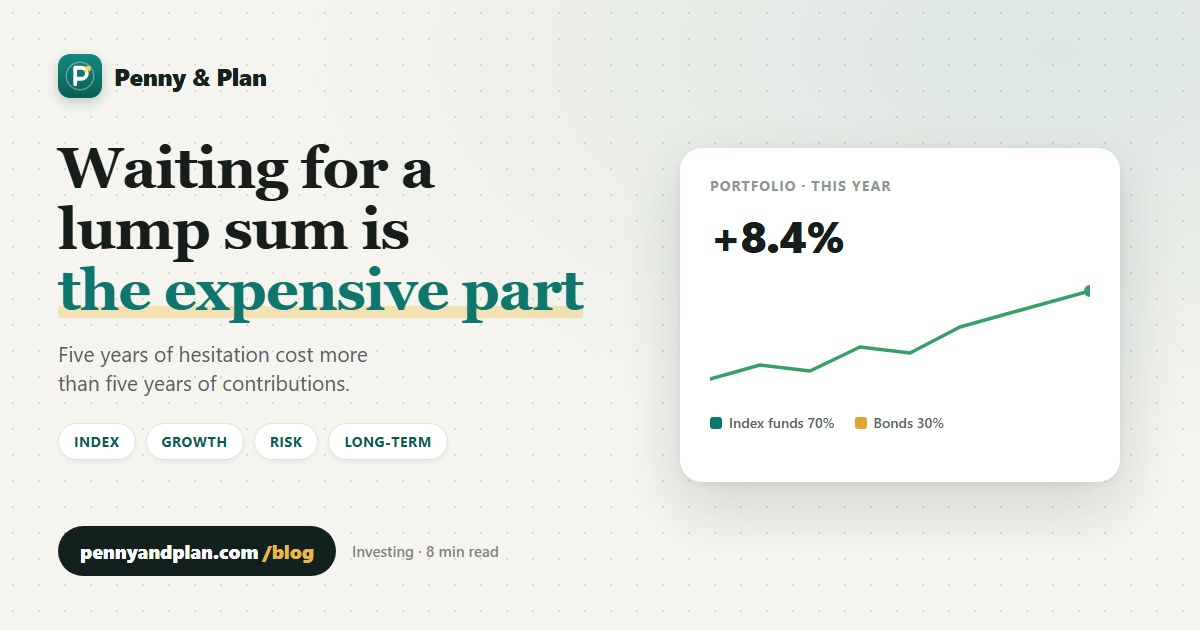
How to Start Investing With Little Money
Almost everyone who says they cannot afford to invest is comparing themselves to a number they invented. There is no threshold. What there is, is a cost to waiting, and it is much larger than most people expect.
Run the arithmetic yourself in the SEC's free compound interest calculator. Fifty dollars a month, invested for 30 years at a 6 percent annual return compounded monthly, ends at roughly 50,200 dollars. The same fifty dollars a month, started five years later and run for 25 years, ends at roughly 34,700 dollars.
The gap is about 15,600 dollars. The difference in what you actually paid in is 3,000 dollars. Those five spent waiting until you "had enough to bother" were the most expensive part of the whole plan, and they cost you nothing to skip.
That is the entire argument for starting small. Everything below is the mechanics.
Two things that genuinely come first
Being told to invest immediately when your finances are not ready is bad advice, so be honest about two items before anything else.
Expensive debt. Paying off a card charging 22 percent is a guaranteed 22 percent return, tax free, with no volatility. No fund will promise you that. Clear the high-rate balances first.
A small cash buffer. Investments fall as well as rise, and being forced to sell during a fall to fix a car turns a paper dip into a real loss. A modest buffer, even a few hundred, prevents that. It does not need to be six months of expenses before you are allowed to begin.
There is one exception that outranks both, and it is the next section.
Take the free money before the clever money
If your employer matches pension or retirement contributions, that match is the highest guaranteed return available to any investor at any wealth level, and it is the thing small savers skip most often because the contribution feels unaffordable. Contribute at least enough to capture the full match even while you are paying down debt. Turning down a 50 percent or 100 percent instant return to save 22 percent interest is arithmetic going the wrong way.
Governments offer their own version of this, and it is aimed squarely at people starting with little:
- United States. The Saver's Credit gives a tax credit worth 50, 20 or 10 percent of what you put into a retirement account, on up to 2,000 dollars of contributions (4,000 for joint filers). The percentage falls as income rises, and the income bands are updated by the IRS each year, so check the current figures before you file. It is a credit, not a deduction, meaning it reduces your tax bill directly.
- United Kingdom. A Lifetime ISA adds a 25 percent government bonus to everything you pay in, up to 4,000 pounds a year, so a maximum bonus of 1,000 pounds annually. You must open it before you turn 40 and can pay in until 50. It is for a first home or for later life, and taking money out for anything else triggers a withdrawal charge, so read that condition before you use it as a general savings pot.
- Canada. There is no direct bonus on a TFSA, but the RRSP deduction reduces taxable income in the year you contribute, and the First Home Savings Account gives a deduction going in and tax-free growth coming out for a first property. Which one suits you depends mainly on your current tax bracket.
Five realistic routes when the amount is small
| Route | Realistic starting amount | What it costs | Best for |
|---|---|---|---|
| Workplace pension or 401(k) | A percentage of pay, often 1 to 5 percent | Usually a low fund charge, sometimes capped by regulation | Anyone whose employer matches, before anything else |
| Regular investing plan into an index fund | Commonly around 25 a month | A fund charge, often a small fraction of a percent | The default for steady monthly contributions |
| Fractional shares of an ETF | The price of a fraction, sometimes 1 | Usually commission-free, watch the spread | Building a position without whole-share prices |
| Robo-advisor or ready-made portfolio | Often 1 to 100 to open | A management fee on top of the fund charge | People who want the allocation decided for them |
| Government-bonus account (LISA, FHSA) | Whatever you can pay in | Withdrawal conditions rather than fees | Named goals like a first home |
If you are not sure what an index fund is or why it is the usual answer here, the mechanics are worth 5 minutes: read what an index fund is and how it works before you pick one.
The fee trap that only punishes small investors
Percentage fees treat everybody the same. Flat fees do not, and this is the single most important thing for someone starting with a small balance.
Look at what identical charges do to different pot sizes:
| Charge | On a 300 pot | On a 30,000 pot |
|---|---|---|
| Flat 5 monthly platform fee | 60 a year, 20 percent | 60 a year, 0.2 percent |
| 5 commission per purchase, monthly | 60 a year, 20 percent | 60 a year, 0.2 percent |
| 0.25 percent platform fee | 0.75 a year | 75 a year |
| 0.07 percent index fund charge | 0.21 a year | 21 a year |
A five-unit dealing charge applied to a 25-unit monthly investment means 20 percent of your money is gone before the market has even opened. You would need a 25 percent return just to break even on the first month. The same charge is a rounding error to somebody with 30,000 invested, which is precisely why fee structures that look reasonable in a comparison table can be ruinous at your size.
So when you are choosing where to start, the screening question is not "which platform has the best app". It is: do they charge me a percentage, and is monthly investing free of commission? Percentage-based charging is the small investor's friend, and there are plenty of providers offering it in all three countries.
Where to hold it: the account matters more than the fund
Two people can buy exactly the same global index fund and keep very different amounts of it, because of the wrapper it sits in.
| United States | United Kingdom | Canada | |
|---|---|---|---|
| Main tax-free or tax-deferred home | 401(k), Traditional IRA, Roth IRA | Stocks and Shares ISA, Lifetime ISA | TFSA, RRSP, FHSA |
| How the break works | Deduction now (Traditional) or tax-free withdrawals later (Roth) | No tax on growth or withdrawals inside an ISA | TFSA is tax-free out, RRSP is deducted going in |
| Extra help for low earners | Saver's Credit on retirement contributions | 25 percent LISA bonus | Contribution room carries forward if unused |
| Typical annual cap | Set by the IRS and updated yearly | 20,000 pounds across all ISAs, 4,000 of it LISA | An annual TFSA dollar limit set each year, plus carried-forward room |
Two details people miss. In the UK, the 20,000 ISA allowance is per person, so a couple has two. In Canada, TFSA room accumulates from the year you became eligible, so someone who has never opened one usually has far more room available than a single year's limit, and money withdrawn is added back to your room the following calendar year. Check your own figure in CRA My Account rather than assuming.
Automate it, then stop watching
Set a standing transfer for the day after payday. Not the end of the month, when the money is gone.
Two reasons this beats investing manually. The first is behavioural: a decision you make once survives, while a decision you remake every month eventually loses to a bad week. The second is mechanical. A fixed contribution buys more units when prices are down and fewer when they are up, which removes the question of whether now is a good moment. You will never pick the bottom, and with a monthly plan you no longer need to.
Then leave it alone. Checking a small balance daily produces anxiety and no information, and the most common way small investors lose money is selling during the first sharp fall they experience. The mechanism doing the actual work is described in how compound interest works, and it needs time far more than your attention.
What to stay away from at the start
Small balances attract the worst products, because the urge to grow a small pot fast is easy to sell to.
Be sceptical of anything promising unusually high or guaranteed returns, anything using leverage or margin, and anything arriving via a social media message or a celebrity advert. The FCA's ScamSmart service exists because investment scams are aggressively targeted, and the warning signs are the same in the US and Canada: pressure to decide quickly, a return that sounds too good, and a firm you cannot find on the regulator's register. Checking the register takes 2 minutes and it is free.
Single stocks are not a scam, but they are a poor first move. A broad index fund gives you hundreds or thousands of companies for the same money, which is the only free thing in investing.
The bottom line
The barrier to starting was never the amount. Clear the expensive debt, keep a small cash buffer, take every scrap of free money on offer from an employer or a government bonus, then put 25 or 50 a month into a broad index fund inside the right tax wrapper, through a provider that charges a percentage rather than a flat fee. Automate it and forget it. The five years you spend waiting to feel ready will cost you more than the contributions themselves.
Frequently Asked Questions
How much money do you need to start investing?
In practice, whatever your provider's minimum is, and for most regular investing plans that is somewhere around 25 dollars, pounds or Canadian dollars a month. Fractional shares mean you no longer have to afford a whole share of an expensive company to own part of it. The real minimum is not a balance, it is a contribution you can repeat every month without stopping.
Should I pay off debt before I start investing?
Clear anything at credit card rates first, because paying off a 22 percent balance is a guaranteed 22 percent return and no investment offers that. The one exception is an employer pension or 401(k) match, which is free money at a rate no card interest can match, so contribute at least enough to get the full match even while you are paying debt down.
Is it better to invest a little every month or wait and invest a lump sum?
For someone building up from nothing, monthly is the only realistic option and it has a useful side effect: your fixed contribution buys more units when prices are low and fewer when they are high, so you never have to guess the right moment. Waiting to accumulate a lump sum simply removes years from the calculation, and years are the input that matters most.
Sources
Primary sources used for this guide. Last checked August 23, 2026.
- Investing BasicsFINRA
- Compound Interest CalculatorUS Securities and Exchange Commission (Investor.gov)
- Retirement Savings Contributions Credit (Saver's Credit)US Internal Revenue Service
- Lifetime ISAGOV.UK
- The Tax-Free Savings Account (TFSA)Canada Revenue Agency
- ScamSmart: avoid investment and pension scamsUK Financial Conduct Authority
Keep reading
 Investing
What Is Diversification in Investing?
What diversification actually protects you from, the four axes that matter, and the overlap traps that make US, UK and Canadian portfolios look safer.
Investing
What Is Diversification in Investing?
What diversification actually protects you from, the four axes that matter, and the overlap traps that make US, UK and Canadian portfolios look safer.
 Investing
Active vs Passive Investing Explained
What active and passive investing actually do with your money, the break-even return an active fund must beat, and how rules differ in the US, UK and Canada.
Investing
Active vs Passive Investing Explained
What active and passive investing actually do with your money, the break-even return an active fund must beat, and how rules differ in the US, UK and Canada.
 Investing
How to Invest in Your 20s and 30s
What to prioritise in your 20s versus your 30s, the account order for the US, UK and Canada, and exactly what a ten year delay costs at the same monthly amount.
Investing
How to Invest in Your 20s and 30s
What to prioritise in your 20s versus your 30s, the account order for the US, UK and Canada, and exactly what a ten year delay costs at the same monthly amount.