How Long Do Late Payments Stay on Your Credit Report?
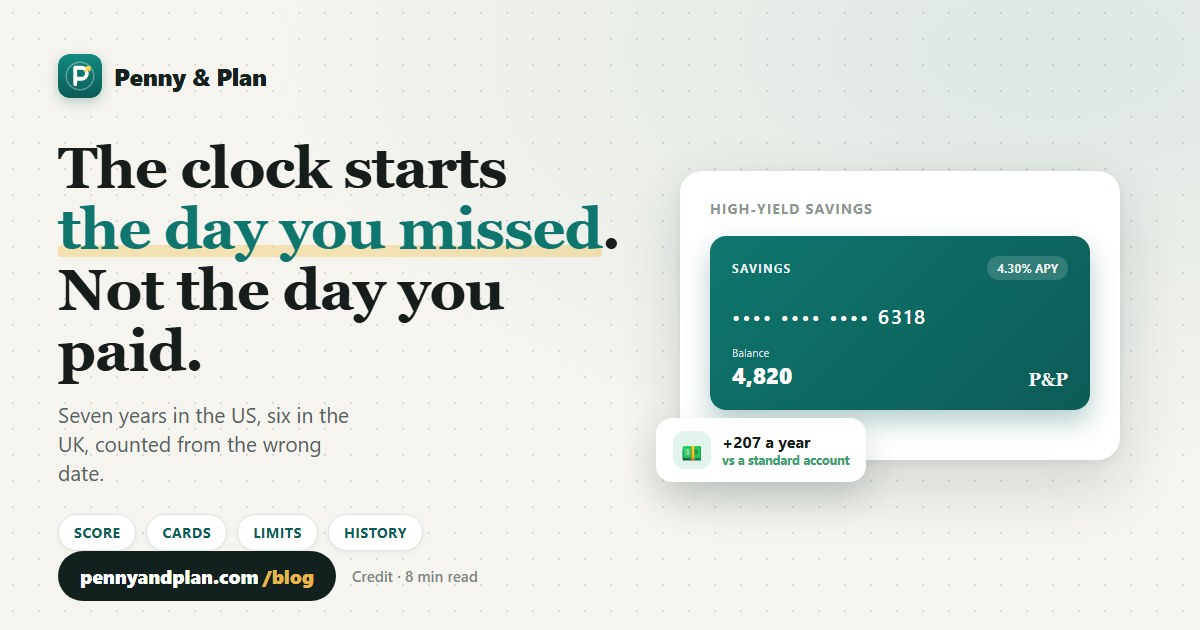
Almost everyone asks this question with the wrong date in mind. They picture the clock starting when they finally cleared the balance, because that is the moment it stopped feeling like a problem. It does not work that way anywhere. The countdown starts on the day the payment was missed, which means the most useful thing you can do with an old late payment is work out its real expiry date rather than guess at one.
The anchor date is the missed payment, not the fix
In the United States this is written into the reporting rules. The CFPB puts the general position simply: a credit reporting company can report most negative information for seven years, and bankruptcies for up to ten. The seven years is measured from the original delinquency, the point at which the account first went past due and never came back to current before the trouble escalated.
That has a counterintuitive consequence. Two people can miss a payment in the same month, one clears it three weeks later and one lets it run for a year, and both entries expire on roughly the same date. Paying quickly does not buy an earlier removal. What it buys is a much less damaging entry in the meantime and, crucially, it stops the sequence before a 30 day late becomes a 90 day late or a charge off.
The UK and Canada anchor things slightly differently but land in the same place: the date the problem started is what counts.
The three countries side by side
| United States | United Kingdom | Canada | |
|---|---|---|---|
| Standard retention | 7 years | 6 years | 6 or 7 years, varies by province or territory |
| Clock starts | Original delinquency date | Date of default, or account settlement | Date of the missed payment or last activity |
| Does paying remove it | No, status changes to paid | No, marked satisfied or partially satisfied | No, marked paid |
| Bankruptcy | Up to 10 years | 6 years from the bankruptcy order | Generally 6 years after discharge for a first bankruptcy, longer for a second |
| Who oversees it | CFPB and FTC under federal credit reporting law | Credit reference agencies under UK data protection law, overseen by the ICO | Provincial and territorial consumer reporting legislation, with FCAC guidance |
The UK row is the one people trip over most. A default is a single, dated event, and it sits on your file for six years from that default date regardless of what happens next. Pay it in full a fortnight later and it does not vanish, it simply gets marked satisfied and carries on ageing quietly for the remaining five years and fifty weeks. Plenty of people delay clearing a default because they assume payment is what triggers the six years. It is the opposite: paying early gets you a satisfied marker that ages out at exactly the same time as an unpaid one would have.
A worked example, with dates
Say you missed a credit card payment in March 2024, went 60 days past due, and cleared the balance in August 2024.
- In the US, the entry can be reported until roughly March 2031, seven years from the March 2024 delinquency. Clearing it in August 2024 changes the entry to a paid, formerly 60 days late account. It does not move the 2031 date.
- In the UK, if the missed payments were recorded as arrears markers on a live account rather than a default, they roll off as the six year window of monthly payment history moves forward, so by around March 2030 that month has scrolled out of view. If it escalated to a registered default in, say, June 2024, the whole default entry sits there until June 2030.
- In Canada, expect the entry to be gone somewhere between March 2030 and March 2031, depending on which province or territory's reporting rules apply to your file.
Now put a number on what it costs you. If that missed payment was on a card carrying a 24 percent APR and a balance of 2,000, the direct cost was a late fee plus about 40 in a month of interest. The indirect cost is the part that lasts. If the entry pushes you from a near prime band into a subprime one when you apply for a 25,000 car loan two years later, a three percentage point rate difference over five years is roughly 2,000 in extra interest. The fee was the cheap part.
Dropping off and mattering are two different things
The retention period is a legal ceiling, not a description of how much the entry hurts. Scoring models weight recency heavily, so the damage curve slopes down steeply from the start.
A rough picture of how that plays out:
- Months 0 to 6. Maximum impact. This is when the entry is doing almost all of its work against you, and when a mortgage or loan application is genuinely worth delaying if you can.
- Months 6 to 24. Meaningful but shrinking, especially if every payment since has been on time. New good history is actively diluting it.
- Years 2 to 4. Marginal for most lenders on most products. Manual underwriters may still ask about it; automated decisions increasingly do not.
- Years 4 to expiry. Largely background noise. It is still visible, but it is rarely the thing standing between you and an approval.
This is the opposite of how credit utilization behaves. Utilization has no memory at all: pay the balance down and next month's snapshot is clean, as though the high balance never happened. Payment history has a very long memory but a fading voice. Knowing which lever you are pulling matters, because if you have a big application coming up in six weeks, utilization is the one you can actually move.
What you can and cannot do about an old late payment
Dispute anything inaccurate. This is the one route that removes an entry outright, and it only works when the entry is genuinely wrong: a payment you can prove was made on time, an account that was never yours, a date that does not match your statements, a duplicate. The FTC's guidance sets out the US process, and you should file with both the credit bureau and the creditor that supplied the information. In Canada the same dispute right runs through the credit bureaus under provincial reporting law. In the UK you raise it with the credit reference agency, which must check it with the lender.
Ask for a goodwill adjustment, if you are in the US. There is no legal right to this, but a polite written request to remove a single isolated late payment from an otherwise long, clean account is occasionally granted, particularly where there was a genuine one off cause. It costs a letter. This is much less of a thing in the UK and Canada, where lenders generally take the line that accurate data stays.
Add context in the UK. If the missed payment has a real explanation, illness, redundancy, a bereavement, you can ask the credit reference agency to attach a Notice of Correction of up to 200 words to the entry. Automated decisions will ignore it, but it routes your application to a human at many lenders, which is sometimes exactly what you want.
Do not pay anyone to remove accurate entries. Credit repair outfits promising to delete legitimate late payments are selling you the dispute process you can run yourself for free, and the regulators in all three countries have been consistent on this for years.
Check the file first, free. In the US you are entitled to free reports from the nationwide credit bureaus through AnnualCreditReport.com, the only site the FTC endorses. In the UK all three agencies offer free statutory access to your file. In Canada, Equifax and TransUnion both provide a free credit report on request. Look up the actual dates rather than working from memory, because the whole calculation turns on a date that is easy to misremember by a year.
One thing worth knowing before it happens again
The gap between "a bit late" and "on your credit report" is wider than most people assume. In the US and Canada, lenders generally do not report until an account is 30 days past due. That is not an invitation to pay late, the fee and the interest are real, but a payment you catch four days after it was due usually never reaches your file at all.
That gap is why autopay for the minimum payment is worth setting up even if you always intend to pay in full manually. The minimum keeps the account out of reporting territory; you pay the rest by hand. It converts the worst outcome from a seven year entry into a small interest charge.
The bottom line
Seven years in the US, six in the UK, six or seven in Canada, and in every case counted from the day you missed rather than the day you fixed it. Paying does not delete the entry and does not shorten the wait, but it changes what the entry says and, more importantly, stops the escalation that would put a much heavier mark on your file. After that, time does the work: by year two or three the thing you are still worrying about is barely registering with lenders. Get the real dates off your report, check them for errors, and then stop treating an ageing late payment as an emergency it stopped being a long time ago.
Frequently Asked Questions
Does paying off a late account remove it from my credit report?
No. Paying updates the status of the entry so it shows as paid or satisfied rather than outstanding, which lenders treat much more favourably, but the record of the missed payment itself stays for the full retention period. The only things that get an accurate entry removed early are a successful dispute over an error and, in the US, a goodwill adjustment that the creditor chooses to make.
How many days late does a payment have to be before it is reported?
In the US and Canada, lenders generally do not report a payment to the credit bureaus until it is 30 days past due, so a payment that is a week late usually costs you a fee and interest rather than a mark on your file. In the UK, monthly payment markers work on a similar cycle, and a full default is normally registered only after a run of missed payments, typically somewhere between three and six months.
Is one late payment really that damaging?
A single 30 day late on an otherwise clean file is the mildest version of this, and its effect shrinks noticeably within a year. What does serious damage is escalation. A 30 day late that becomes 60, then 90, then a charge off or default is not one event on your report, it is a sequence, and the later entries carry far more weight than the first one.
Sources
Primary sources used for this guide. Last checked August 17, 2026.
- How long does negative information stay on my credit report?US Consumer Financial Protection Bureau
- Credit reports and scoresUS Consumer Financial Protection Bureau
- Disputing Errors on Your Credit ReportsUS Federal Trade Commission
- Free Credit ReportsUS Federal Trade Commission
- CreditUK Information Commissioner's Office
- Credit report and score basicsFinancial Consumer Agency of Canada
Keep reading
 Credit
What Hurts Your Credit Score the Most?
Not all credit damage is equal. The harms ranked by how far they drop you and how long they last, plus the one thing that heals in a single billing cycle.
Credit
What Hurts Your Credit Score the Most?
Not all credit damage is equal. The harms ranked by how far they drop you and how long they last, plus the one thing that heals in a single billing cycle.
 Credit
What Is a Secured Credit Card?
A secured card is not a prepaid card. How the deposit works as collateral, what one really costs to run for a year, and how the US, UK and Canada differ.
Credit
What Is a Secured Credit Card?
A secured card is not a prepaid card. How the deposit works as collateral, what one really costs to run for a year, and how the US, UK and Canada differ.
 Credit
How to Check Your Credit Report for Free
The free routes to your actual credit report in the US, UK and Canada, the extra free copies most people never claim, and what to read once you have it.
Credit
How to Check Your Credit Report for Free
The free routes to your actual credit report in the US, UK and Canada, the extra free copies most people never claim, and what to read once you have it.