The 50/30/20 Budget Rule Explained (With Real Examples)
If budgeting spreadsheets make your eyes glaze over, the 50/30/20 rule is the antidote. It splits your take-home pay into just three buckets, which makes it one of the easiest budgets to actually stick to. The idea was popularised by US senator and bankruptcy expert Elizabeth Warren in her book on family finances, and it has endured because it is memorable enough to run in your head. Here is how it works, with real monthly examples for the US, UK and Canada.
What the 50/30/20 rule means
You divide your after-tax income into three parts:
- 50% Needs. The things you must pay to live: rent or mortgage, utilities, groceries, transport, insurance and minimum debt payments.
- 30% Wants. The nice-to-haves: eating out, streaming, hobbies, travel, new clothes you do not strictly need.
- 20% Savings and debt. Building an emergency fund, saving or investing for the future, and any extra debt payments beyond the minimum.
The whole point is simplicity. Three numbers, no tracking of forty separate categories. The one distinction worth getting right is the line between a need and a want, because that is where most people quietly cheat. A basic phone plan is a need; the top-tier handset on a 24-month contract is mostly a want. Groceries are a need; the daily bought lunch is a want. Sort honestly and the rest of the method looks after itself.
A real monthly example
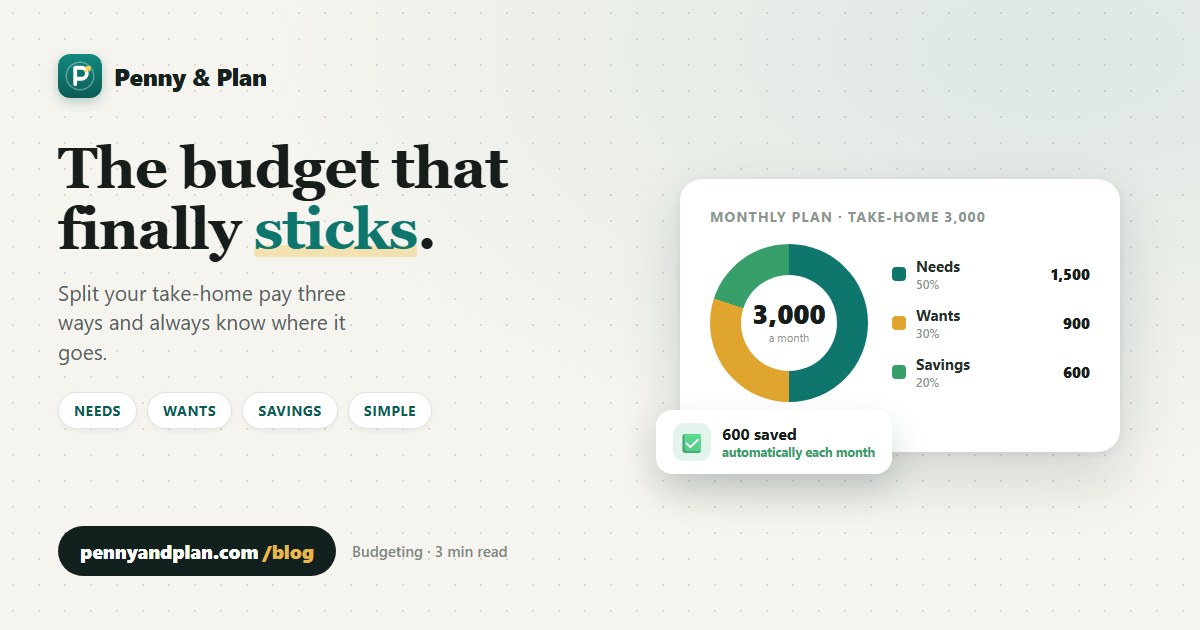
Say your take-home pay is 3,000 in your local currency after tax. The rule splits it like this:
| Bucket | Share | Amount |
|---|---|---|
| Needs | 50% | 1,500 |
| Wants | 30% | 900 |
| Savings & debt | 20% | 600 |
So 1,500 covers your rent, bills and food. 900 is guilt-free spending on the things you enjoy. And 600 goes straight to your emergency fund, savings or paying down debt faster. If your income is 2,000, the same percentages give you 1,000 / 600 / 400.
Crucially, that "after tax" starting point already differs by country. In the US your take-home is what remains after federal and state tax, Social Security and Medicare. In the UK it is after income tax, National Insurance and usually workplace pension contributions. In Canada it is after federal and provincial tax, CPP and EI. Always run the percentages on the figure that actually reaches your account, not your gross salary, or every bucket will be too large.
How the buckets differ across the US, UK and Canada
The rule is universal but the contents of each bucket are not, because the cost of essentials and the tools for the savings bucket vary by country.
| Bucket | United States | United Kingdom | Canada |
|---|---|---|---|
| Needs | Rent, health insurance premiums, car costs, groceries | Rent, council tax, energy, groceries | Rent, provincial health premiums where they apply, groceries |
| Wants | Streaming, dining, travel, hobbies | The same, with TV Licence often sitting on the line | The same |
| Savings & debt | 401(k), Roth IRA, HSA, extra debt payments | ISA, workplace pension, LISA for a first home | RRSP, TFSA, extra debt payments |
Healthcare is the sharpest contrast. In the US, insurance premiums and out-of-pocket costs are a genuine need that can consume a real slice of the 50 percent, whereas UK and Canadian residents fund most healthcare through general taxation, so it never appears in the budget at all. When you fill the savings bucket, use the tax-advantaged account for your country: an ISA or workplace pension in the UK, a TFSA or RRSP in Canada, a 401(k) or IRA in the US.
Why it works
Most budgets fail because they are too detailed to maintain. The 50/30/20 rule succeeds for three reasons:
- It is memorable. You can do the math in your head.
- It protects your future without banning fun. The 30 percent wants bucket means you never feel deprived, which is what usually causes people to quit budgeting.
- It forces saving to happen first, not with whatever happens to be left over at month end, which is often nothing. This is the "pay yourself first" principle, and automating the transfer on payday is what makes it stick.
When the rule does not fit
The 50/30/20 split assumes needs fit inside half your income. In expensive cities such as London, New York, San Francisco, Toronto or Vancouver, rent alone can blow past that. National saving rates published by bodies like the US Bureau of Economic Analysis show that household saving swings a good deal from year to year, which is a reminder that 20 percent is a target, not a constant. If needs will not fit, do not abandon the idea, adjust the ratios:
- Try 60/20/20 or 70/20/10 while your rent is high.
- Keep the savings bucket sacred even if you shrink it. Saving something every month builds the habit that matters most.
- Revisit the split whenever your income rises. A raise is the perfect moment to push savings back up toward 20 percent instead of inflating your lifestyle.
As a worked example, on 3,000 take-home with rent that eats 1,650, a strict 50 percent needs cap of 1,500 is already impossible. Switching to 60/20/20 gives 1,800 for needs, 600 for wants and 600 still saved. You keep the discipline of paying yourself first while being honest about your rent.
How to start this month
- Find your real take-home pay (after tax and deductions).
- Multiply it by 0.5, 0.3 and 0.2 to get your three targets.
- Automate the savings bucket so it leaves your account the day you get paid.
- Track only which bucket each expense falls into, nothing more detailed.
- Check in once a month and adjust.
50/30/20 budget calculator
Enter your monthly take-home pay to split it into needs, wants and savings.
A starting guide, not a rule. Adjust the split to fit high-rent areas or aggressive saving goals.The bottom line
The 50/30/20 rule is not perfect, and it is not meant to be. It is a starting framework that turns budgeting from a chore into three simple numbers. Get the habit going with whatever ratios your real life allows, use the tax-advantaged savings account for your country, automate your savings, and tighten the split as your income grows. That is enough to put most people ahead of where they were last year.
Frequently Asked Questions
Is the 50/30/20 rule actually good?
It is a solid starting point for beginners because it is simple and balances living today with saving for later. It works less well in very high-cost cities, where needs alone can eat more than 50 percent, so treat the numbers as a target, not a law.
Does the 20 percent include debt payments?
The minimum payments on debts count as needs. Any extra you pay on top to clear debt faster comes out of the 20 percent savings-and-debt bucket.
What if I cannot hit 20 percent savings?
Start with whatever you can, even 5 percent, and raise it by one percent every couple of months. The habit matters more than the exact figure at the start.
Sources
Primary sources used for this guide. Last checked August 10, 2026.
- Consumer tools and financial educationUS Consumer Financial Protection Bureau
- Make a budgetFinancial Consumer Agency of Canada
- Personal Saving RateUS Bureau of Economic Analysis
Keep reading
 Budgeting
How to Set Financial Goals That Actually Stick
Why most money goals quietly die, and the four-part structure that keeps them alive: a real number, a date, an automatic transfer and a monthly review.
Budgeting
How to Set Financial Goals That Actually Stick
Why most money goals quietly die, and the four-part structure that keeps them alive: a real number, a date, an automatic transfer and a monthly review.
 Budgeting
How to Track Your Spending (Simple Methods)
Four simple ways to track your spending, how to pick the one you will actually stick with, and what the first four weeks of data will tell you about your money.
Budgeting
How to Track Your Spending (Simple Methods)
Four simple ways to track your spending, how to pick the one you will actually stick with, and what the first four weeks of data will tell you about your money.
 Budgeting
How to Stop Living Paycheck to Paycheck
Why the paycheck-to-paycheck trap is a timing problem more than an income problem, and the order of moves that breaks it for good in the US, UK and Canada.
Budgeting
How to Stop Living Paycheck to Paycheck
Why the paycheck-to-paycheck trap is a timing problem more than an income problem, and the order of moves that breaks it for good in the US, UK and Canada.